 by
Human Resource Development (HRD) refers to the process of developing the skills, knowledge, and abilities of employees in an organization. It focuses on improving employee performance and preparing them for future responsibilities. HRD includes activities such as training, development, career planning, and performance management. The main aim of HRD is to enhance employee capabilities and ensure continuous learning. In today’s competitive environment, organizations need skilled and adaptable employees to achieve success. HRD helps in building a competent workforce and improving productivity. It also increases employee motivation, job satisfaction, and commitment. Effective HRD contributes to both individual growth and overall organizational development and long term success.
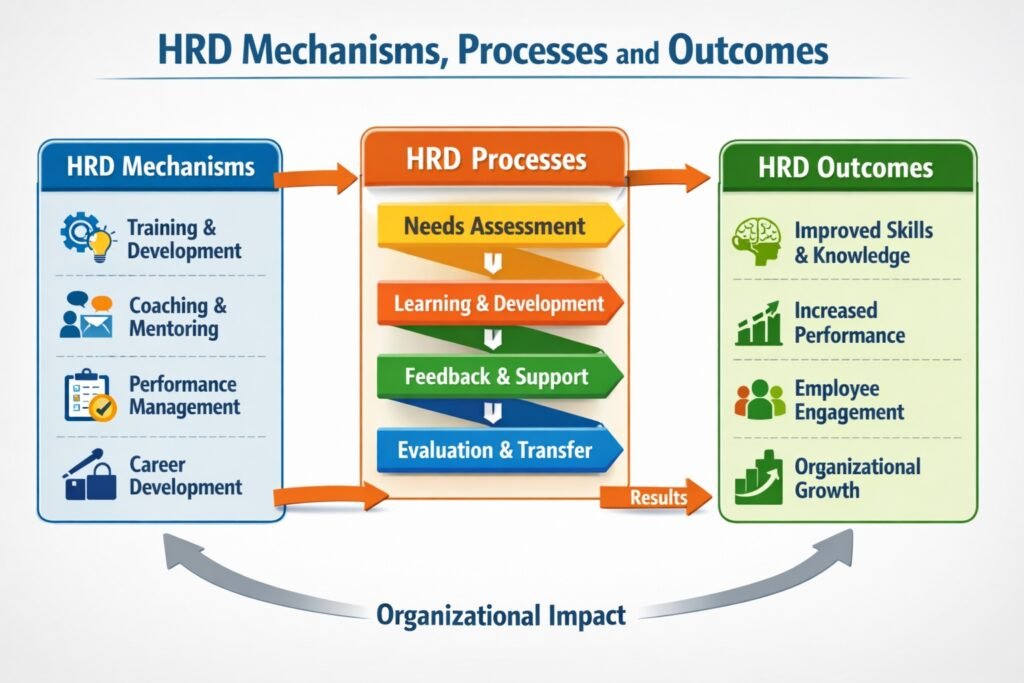
HRD Mechanisms:
1. Performance Appraisal
Performance appraisal is a systematic mechanism for evaluating employee performance against predetermined goals and standards. It involves setting objectives, monitoring progress, providing feedback, and rating performance for decisions on rewards, promotions, training needs, and career development. For Indian organizations like HDFC Bank, annual or quarterly appraisals link individual contributions to business results. Effective appraisal systems are transparent, fair, and developmental not just administrative. They identify high performers for recognition and low performers for improvement plans. However, many Indian companies struggle with rater bias, recency effect, and lack of ongoing feedback. When done well, performance appraisal feeds directly into other HRD mechanisms training needs analysis, career planning, and succession management. Without proper appraisal, development efforts are blind, and employees feel unrecognized. Modern trends include continuous feedback, 360-degree appraisals, and technology-enabled tracking.
2. Potential Appraisal
Potential appraisal assesses an employee’s hidden talents and future capabilities for assuming higher responsibilities. Unlike performance appraisal which evaluates past results, potential appraisal predicts future readiness. Methods include assessment centers, psychological tests, case studies, role plays, and leadership simulations. For Indian IT companies like Infosys, potential appraisal identifies high-potential employees for leadership pipelines. The mechanism answers: Who is ready for promotion now? Who needs development before next level? Who may never grow beyond current role? Potential appraisal must be distinguished from performance a high performer may lack strategic thinking for senior roles, while a moderate performer may have high potential. Indian organizations often confuse the two, promoting top performers into roles they cannot handle. Proper potential appraisal requires trained assessors, multiple methods, and calibration across departments. It is a critical input for succession planning and career development.
3. Career Planning and Development
Career planning is a mechanism that helps employees chart their professional journey within the organization. It involves self-assessment (interests, values, strengths), exploration of possible career paths, goal setting, and action planning. Career development provides the resources and opportunities to achieve those goals—training, mentoring, job rotation, stretch assignments. For an Indian bank, a probationary officer might plan a path: branch manager by year 5, regional head by year 10, and general manager by year 15. HRD facilitates career planning through career workshops, online portals showing career ladders, and career counseling sessions. Without this mechanism, employees feel stuck, leading to stagnation and attrition. Indian organizations with strong career planning (TCS, HDFC Bank) have lower turnover. However, career planning must be realistic—not everyone can become CEO. Dual career ladders (technical and managerial) accommodate different aspirations. Career planning aligns individual dreams with organizational needs.
4. Succession Planning
Succession planning is a proactive mechanism to identify and prepare internal candidates for critical leadership and key roles before they become vacant. It involves identifying pivotal positions, assessing potential successors, creating development plans, and periodically reviewing readiness. For Indian family businesses like Murugappa Group or PSUs facing mass retirements, succession planning ensures leadership continuity. The mechanism uses replacement charts showing incumbents, ready-now successors, and ready-later successors with timelines. Succession planning also includes emergency succession (unexpected departure) and developmental succession (planned retirement). Without it, organizations panic-hire external candidates who may not fit culture or take months to become effective. Indian IT companies like Wipro have robust succession plans for senior roles. However, succession planning must be dynamic successors may leave, new high-potentials emerge, and business needs change. Regular review (quarterly or bi-annually) is essential. The mechanism builds a talent bench and motivates high-potential employees.
5. Training and Learning Programs
Training and learning programs are formal interventions designed to build specific knowledge, skills, and attitudes required for job performance and career growth. They range from technical training (software, machine operation) to behavioral training (communication, leadership) to compliance training (safety, POSH). Delivery methods include classroom, e-learning, on-the-job training, simulations, and workshops. For an Indian BPO, training programs might include accent neutralization, customer handling, and CRM software. HRD mechanisms include training needs identification (from appraisals, business plans), program design, delivery management, and evaluation (Kirkpatrick levels). Leading Indian organizations like TCS have internal learning universities (TCS BPS Learning Academy) with thousands of courses. However, training without transfer support is wasted. Effective mechanisms include pre-training manager discussions, action planning, and post-training reinforcement. Training must be aligned with business goals—not just popular topics. Learning programs should be accessible, engaging, and measurable for continuous improvement.
6. Mentoring
Mentoring is a relationship-based HRD mechanism where an experienced senior (mentor) guides a junior employee (mentee) on career development, organizational navigation, and professional growth. Unlike coaching which focuses on specific skills, mentoring is broader and longer-term. For Indian organizations with hierarchical cultures, mentoring helps juniors understand unwritten rules, build networks, and gain confidence. Effective mentoring programs match mentors and mentees based on development needs, not random assignment. Training mentors on active listening, feedback, and goal setting improves outcomes. Formal mentoring programs include structured meetings (monthly), goal setting (e.g., prepare for next role), and duration (6-12 months). Informal mentoring happens naturally but cannot be relied upon. Indian companies like Tata Motors and Infosys have formal mentoring programs. Mentoring benefits both parties—mentors gain fresh perspectives and leadership practice; mentees gain guidance and sponsorship. Without mentoring, talented employees may leave due to lack of direction and advocacy.
7. Coaching
Coaching is a short-term, performance-focused HRD mechanism where a coach (often a manager or external professional) helps an employee improve specific skills, overcome performance problems, or achieve particular goals. Unlike mentoring, coaching is task-oriented and time-bound. For an Indian sales executive missing targets, coaching might involve call observation, feedback, role play, and action planning over eight weeks. Coaching can be manager-led (integrated into daily supervision) or external (for senior leaders or sensitive issues). Effective coaching uses the GROW model (Goal, Reality, Options, Will) and emphasizes questions over advice. Indian organizations increasingly train managers in coaching skills to replace directive “tell” styles. Coaching addresses performance gaps identified in appraisals, prepares employees for new roles, or supports behavior change after feedback. Without coaching, employees repeat same mistakes, and training transfer fails. Coaching is cost-effective compared to formal training and can be delivered just-in-time. It turns managers into developers, not just evaluators.
8. Feedback and Performance Counseling
Feedback is the mechanism of providing specific, timely information to employees about their performance, behavior, or impact on others. Performance counseling extends feedback into a structured conversation that identifies root causes of performance gaps and creates improvement plans. For an Indian IT project manager, feedback might be: “Your team misses deadlines because requirements are unclear at project start.” Counseling explores why requirements are unclear (lack of client discovery skills, time pressure) and develops an action plan (attend discovery workshop, block two days for requirements upfront). Effective feedback is specific, behavioral, non-judgmental, and forward-looking. Annual feedback is insufficient ongoing feedback (weekly or monthly) drives continuous improvement. Many Indian organizations struggle with feedback avoidance due to hierarchical norms and fear of confrontation. HRD mechanisms include training managers in feedback skills, creating feedback forms and templates, and establishing regular feedback cadences. Without feedback, employees operate in the dark, repeating ineffective behaviors and missing growth opportunities.
9. Organization Development (OD) Interventions
Organization Development interventions are planned, systematic HRD mechanisms for improving overall organizational health, culture, and effectiveness. OD addresses systemic issues—low trust, poor communication, inter-departmental conflict, resistance to change rather than individual skill gaps. Common OD interventions in Indian organizations include team building workshops, survey feedback (employee engagement surveys with action planning), large group interventions (future search, open space technology), process consultation (improving meetings or decision-making), and culture transformation programs. For an Indian manufacturing plant with union-management conflict, OD might involve joint problem-solving committees and relationship-building offsites. OD differs from training—training changes individuals; OD changes systems. OD requires skilled external or internal facilitators who understand group dynamics and change management. Without OD, organizations develop dysfunctional patterns that individual training cannot fix. Indian organizations like L&T and Tata Steel have used OD successfully. OD interventions are longer-term (months to years) and require leadership commitment to implement recommendations, not just diagnose problems.
10. Rewards and Recognition for Development
Rewards and recognition mechanisms reinforce learning and development behaviors. They answer: What gets rewarded gets repeated. HRD-related rewards include certificates for course completion, badges for skill mastery, learning leaderboards, promotions linked to training milestones, and monetary incentives for certifications. For an Indian IT company, an employee completing cloud certification might receive a bonus, public recognition in town hall, and priority for cloud projects. Recognition can be peer-to-peer (nominate someone who helped you learn) or manager-led. Without reinforcement, employees deprioritize development amid daily production pressure. However, poorly designed mechanisms reward attendance, not application employees complete courses but do not change behavior. Effective mechanisms link rewards to learning transfer (manager certifies application) or business impact (productivity improvement from new skills). Indian organizations like Infosys have point-based learning systems where accumulated points convert into gift vouchers or leave. Rewards must be timely, meaningful, and fair to motivate sustained development effort across all employee levels.
HRD Processes:
1. Need Assessment Process
The need assessment process identifies gaps between current and required employee competencies. It begins with organizational analysis reviewing business goals, strategy, and culture to determine where development is needed. Task analysis follows, examining specific job roles to identify required knowledge, skills, and attitudes. Individual analysis then assesses each employee’s current capabilities against those requirements using performance appraisals, tests, or observations. For an Indian IT company shifting to AI services, organizational analysis reveals strategic need for AI skills; task analysis specifies Python, machine learning, and data visualization as required; individual analysis identifies which engineers lack these skills. Data collection methods include surveys, interviews, focus groups, and document analysis. Without proper need assessment, HRD becomes random training that wastes resources. The process outputs a prioritized list of training needs linked to business impact.
2. Training Design Process
The training design process translates identified needs into structured learning experiences. It begins with setting learning objectives—specific, measurable statements of what participants will know or do after training. For an Indian BPO customer service training, an objective might be: “Handle irate customer calls using the LAA (Listen, Acknowledge, Act) technique within 4 minutes.” Design then selects content (topics, examples, exercises), methods (classroom, e-learning, simulation), materials (handouts, slides, job aids), and duration. It also considers learner characteristics (education level, language, prior knowledge) and constraints (budget, time, venue). For blue-collar workers, design uses local language, visuals, and hands-on practice rather than theory. Pilot testing with a small group identifies flaws before full rollout. Good design ensures engagement, retention, and transfer. Poor design results in disinterested participants and no behavior change. Design documentation includes facilitator guides, participant workbooks, and evaluation tools.
3. Training Delivery Process
The training delivery process implements the designed program with actual participants. It covers logistics—scheduling dates and times, booking venues, arranging equipment (projectors, computers, Wi-Fi), printing materials, and communicating with participants. For an Indian manufacturing plant with shift workers, delivery must schedule multiple batches to cover all employees without disrupting production. Delivery also involves trainer selection and preparation—ensuring instructors understand both content and adult learning principles. During delivery, facilitators create a positive learning environment, manage group dynamics, check for understanding, and adapt pacing based on participant feedback. For virtual training, delivery includes platform setup (Zoom, Teams), breakout rooms, polls, and chat moderation. Post-delivery, attendance records are updated in the Learning Management System. Delivery failures—cancelled sessions, broken technology, uncomfortable rooms—undermine even well-designed programs. Successful delivery requires project management skills, contingency plans, and attention to participant experience.
4. Transfer of Learning Process
The transfer of learning process ensures that training knowledge and skills apply to actual job performance. It begins before training with manager-employee conversations: discussing why the training matters, setting application expectations, and planning how new skills will be used. During training, participants create action plans specifying what they will do differently and when. After training, transfer support includes manager coaching, peer accountability groups, refresher sessions, and access to job aids or online resources. For an Indian sales team trained on a new CRM, transfer means managers checking data entry daily, weekly team reviews of CRM usage, and removing access to the old system. Without transfer, training becomes entertainment. The work environment must enable transfer—employees need time, resources, and permission to try new methods. Recognition and rewards for application reinforce transfer. Organizations with strong transfer processes see behavior change and business results from training investments.
5. Evaluation Process
The evaluation process measures the effectiveness and impact of HRD interventions. Using Kirkpatrick’s four levels, it assesses: reaction (did participants like it? via feedback forms), learning (did they acquire knowledge? via pre-post tests), behavior (did they apply on the job? via manager observation or self-report), and results (did business outcomes improve? via productivity, quality, sales data). For an Indian call center accent training, evaluation might show: Level 1—4.5/5 satisfaction; Level 2—30 percent improvement in pronunciation test; Level 3—customer satisfaction scores up 10 percent; Level 4—call resolution time reduced 15 percent. ROI calculation compares monetary benefits to costs. Evaluation also includes formative assessment during design and delivery to enable mid-course corrections. Many Indian organizations stop at Level 1, which correlates poorly with actual learning. Comprehensive evaluation requires access to business data and analytical skills. Without evaluation, HRD cannot demonstrate value, justify budgets, or improve programs. Results feed back into need assessment, closing the HRD cycle.
6. Performance Management Process
The performance management process links individual goals to organizational strategy and identifies development needs. It begins with goal setting at the start of the performance period—managers and employees jointly define SMART goals aligned with department and company objectives. For an Indian bank branch manager, goals might include deposit growth, digital adoption, and customer satisfaction targets. Throughout the period, ongoing feedback and coaching occur, not just annual reviews. Mid-year reviews assess progress and adjust goals if business conditions change. The annual appraisal evaluates results against goals, assigns a rating, and determines rewards (bonus, promotion) and consequences (performance improvement plan). Crucially for HRD, the process identifies skill gaps an employee missing digital adoption targets may need training on digital tools or customer persuasion. Performance management feeds training needs, career planning, and succession decisions. Without it, development is disconnected from actual job requirements, and employees lack accountability for applying learning.
7. Career Planning Process
The career planning process helps employees identify their long-term professional goals and create development paths to achieve them within the organization. It begins with self-assessment—employees reflect on their interests, values, strengths, and weaknesses using tools like career anchor questionnaires or SWOT analysis. Next, career exploration identifies possible paths within the organization using career ladders (technical, managerial, project-based) and information from HR or mentors. Goal setting follows—specific, time-bound career objectives such as “Become a team leader within 24 months.” The action plan specifies development activities: training programs, stretch assignments, mentoring, job rotations. Regular career discussions between employee and manager review progress and adjust plans as aspirations or business needs change. For Indian IT employees, career planning prevents stagnation and reduces attrition. Without this process, talented employees leave because they see no future. Organizations with strong career planning (Infosys, HDFC Bank) have higher retention and internal fill rates for senior roles.
8. Succession Planning Process
The succession planning process identifies critical roles and develops internal candidates to fill them before vacancies occur. It begins with identifying key positions—roles that are strategic, hard-to-fill, or have unique knowledge. Next, potential successors are identified using performance data, potential assessments, and manager nominations. For each successor, readiness is rated: ready now (can take over immediately), ready in 1-2 years (needs some development), or ready in 3-5 years (high potential but needs significant development). Individual development plans are created for each successor, specifying training, mentoring, stretch assignments, and job rotations needed to reach readiness. Progress is reviewed quarterly or bi-annually. For Indian PSUs facing mass retirements and family businesses transitioning to professional management, succession planning is critical. Without it, organizations panic-hire external candidates who may not fit culture or take months to become effective. Succession planning builds a talent bench, motivates high-potential employees, and ensures business continuity when key people leave.
9. Mentoring Process
The mentoring process establishes structured developmental relationships between senior experienced employees (mentors) and junior employees (mentees). It begins with mentor and mentee selection matching based on mentee’s development needs and mentor’s expertise. For Indian organizations, mentoring helps juniors navigate unwritten rules, build networks, and gain confidence. The process includes mentor training (active listening, goal setting, feedback, confidentiality) and mentee orientation (how to use mentor time effectively). Regular meetings are scheduled (typically monthly for 6-12 months) with clear agendas. Mentoring goals are set career guidance, skill development, organizational navigation, or sponsorship. Progress is reviewed at midpoint and end of the formal period. Unlike coaching which focuses on immediate performance, mentoring is broader and longer-term. Without formal process, mentoring happens randomly, favoring those with natural access to senior leaders. Effective mentoring programs track participation, satisfaction, and outcomes (promotions, retention of mentees). Mentoring benefits both parties—mentors gain fresh perspectives and leadership practice.
10. Organization Development (OD) Process
The organization development process is a systematic approach to improving overall organizational health and effectiveness. It begins with diagnosis collecting data through surveys, interviews, focus groups, and observations to identify issues like low trust, poor communication, or inter-departmental conflict. For an Indian manufacturing plant with union unrest, diagnosis might reveal perceptions of unfair treatment. Feedback shares findings with stakeholders, building ownership for change. Action planning involves stakeholders designing interventions team building, process consultation, culture workshops, or structural changes. Implementation executes the plan with skilled facilitators. Evaluation assesses whether interventions achieved desired outcomes (e.g., reduced grievances, improved collaboration). OD differs from training—training changes individuals; OD changes systems. The process is iterative evaluation may reveal new issues, starting another cycle. OD requires skilled internal or external facilitators who understand group dynamics. Without OD, organizations develop dysfunctional patterns that individual training cannot fix. Indian organizations like Tata Steel and L&T have used OD successfully for culture transformation.
HRD Outcomes:
1. Competent Employees
The most direct outcome of HRD is a competent workforce—employees who possess the knowledge, skills, and attitudes required to perform their jobs effectively. Competence includes technical skills (operating machinery, coding, accounting), behavioral skills (communication, teamwork, problem-solving), and conceptual skills (strategic thinking, decision-making). For an Indian IT company, HRD outcomes include developers proficient in cloud computing, project managers skilled in agile methodologies, and leaders capable of strategic planning. Competent employees make fewer errors, work faster, handle customers better, and adapt to changes more readily. Without HRD, competence deteriorates as technology evolves and job demands change. Competence is measured through tests, certifications, performance appraisals, and observation. Organizations like TCS and Infosys track competence through internal certifications and skill matrices. Competent employees are confident, require less supervision, and contribute more to organizational goals. Competence is the foundation for all other HRD outcomes.
2. Improved Individual Performance
HRD directly enhances how well employees perform their specific job roles. Improved performance means higher productivity (more output per hour), better quality (fewer defects or errors), faster service delivery, and greater customer satisfaction. For an Indian BPO agent, HRD outcomes include reduced average call handling time, increased first-call resolution, and higher customer satisfaction scores. For a factory worker, improved performance means lower rejection rates and higher production targets achieved. Performance improvement is measured through key performance indicators tracked before and after HRD interventions. The link between HRD and performance is strongest when training addresses identified skill gaps and when transfer of learning is supported by managers. Without performance improvement, HRD cannot justify its investment. Indian organizations like HDFC Bank and Maruti Suzuki demonstrate that systematic HRD leads to measurable performance gains. Improved individual performance aggregates into team and organizational performance improvement.
3. Enhanced Organizational Performance
When individual employees perform better, organizational performance improves as well. Enhanced organizational performance includes higher profitability, increased market share, faster growth, better customer retention, and improved quality metrics. For an Indian manufacturing company, HRD outcomes might include reduced production costs, lower defect rates, and higher on-time delivery. For a bank, HRD contributes to increased digital adoption rates, reduced loan processing time, and higher cross-selling success. The link between HRD and organizational performance is mediated by employee competence and motivation. Strategic HRD aligned with business goals produces stronger performance outcomes than isolated training activities. Measurement includes return on investment calculations—comparing monetary benefits of HRD to costs. Indian organizations like Asian Paints and HDFC Bank have demonstrated that sustained HRD investment correlates with industry-leading financial performance. Enhanced organizational performance justifies HRD budgets and elevates HRD from cost center to strategic partner.
4. Higher Employee Commitment and Engagement
HRD outcomes include psychological attachment and emotional investment in the organization. When employees receive training, career development, and mentoring, they perceive that the organization values them, leading to reciprocal commitment. Committed employees identify with organizational goals, exert discretionary effort (working beyond minimum requirements), and stay with the organization even when other offers arise. Engaged employees are enthusiastic about their work, find meaning in their roles, and proactively contribute ideas. For Indian IT companies, HRD programs have reduced attrition and improved engagement scores measured through surveys. Commitment is measured through retention rates, absenteeism, and engagement survey dimensions like pride in organization and willingness to recommend as employer. Without HRD, employees feel expendable and disengaged, leading to presenteeism (physically present but mentally absent) and quiet quitting. Indian organizations with strong HRD (Tata Group, Infosys) consistently rank high in employee engagement surveys.
5. Lower Attrition and Improved Retention
HRD directly reduces employee turnover by addressing key reasons people leave: lack of growth opportunities, skill stagnation, and feeling undervalued. When organizations invest in training, career planning, and succession development, employees see a future and stay. For Indian BPOs with historically high attrition (30-40 percent), HRD interventions like career pathing, skill development, and mentoring have reduced turnover to 15-20 percent. For IT companies, retention of high-potential employees improves when they receive leadership development and sponsorship. Retention outcomes are measured through attrition rates (voluntary separations), tenure distribution, and exit interview reasons. Lower attrition reduces recruitment and training costs, preserves organizational knowledge, and maintains customer relationships. Indian organizations like HDFC Bank and TCS have lower attrition than industry averages due to systematic HRD. Without HRD, talented employees leave for competitors offering better development, creating a vicious cycle of constant hiring and loss of institutional memory.
6. Stronger Leadership Pipeline
HRD builds a pipeline of future leaders by identifying high-potential employees and preparing them for senior roles through targeted development. Leadership outcomes include a pool of ready-now successors for critical positions, reduced reliance on expensive external hires, and smoother leadership transitions. For Indian family businesses, HRD outcomes include grooming next-generation family members and professional managers for leadership. For PSUs facing mass retirements, HRD builds successors from within. Leadership pipeline strength is measured through succession planning metrics: fill rate for senior roles from internal candidates, time to fill critical positions, and bench strength (number of ready-now successors per key role). Without HRD, organizations face leadership crises when senior people leave unexpectedly, panic-hiring external candidates who may not fit culture. Indian organizations like Tata Motors and HDFC Bank have robust leadership pipelines. Leadership development includes mentoring, stretch assignments, executive education, and rotational programs.
7. Learning Culture
HRD outcomes include the development of a learning culture—an environment where continuous learning is valued, encouraged, and rewarded. In a learning culture, employees proactively seek knowledge, share insights with colleagues, experiment without fear of failure, and view mistakes as learning opportunities. Learning culture is measured through surveys assessing psychological safety, time allocated for learning, knowledge sharing behaviors, and leadership modeling of learning. For Indian organizations like Infosys, learning culture means Friday afternoons dedicated to self-directed learning, internal wikis where employees document solutions, and recognition for teaching others. Without HRD, learning is random and individual; with HRD, learning becomes systemic and social. A learning culture reduces dependency on external consultants, accelerates problem-solving, and makes the organization adaptable to change. Learning culture is both an outcome and a enabler—it supports all other HRD outcomes. Building learning culture requires years of consistent HRD investment and leadership commitment.
8. Improved Quality of Work Life
HRD contributes to employee well-being and satisfaction beyond productivity. Improved quality of work life includes reduced role ambiguity (clear expectations from performance management), increased autonomy (empowerment from competence), supportive relationships (mentoring and teamwork), growth opportunities (career planning), and work-life balance (flexibility enabled by skills). For Indian IT employees suffering burnout, HRD outcomes include stress management training, workload distribution skills, and manager training in empathetic leadership. For manufacturing workers, HRD outcomes include safety training reducing accidents and skill development reducing frustration. Quality of work life is measured through satisfaction surveys, stress levels, absenteeism, and health metrics. Without HRD, employees experience stagnation, role confusion, and lack of support, leading to poor mental health and turnover. Indian organizations like Wipro and Tata Steel have HRD programs explicitly targeting well-being. Improved quality of work life benefits both employees (happiness, health) and organizations (productivity, retention, employer brand).
9. Enhanced Innovation and Problem-Solving
HRD builds employees’ ability to identify problems, generate solutions, and implement improvements. Innovation outcomes include new product ideas, process improvements, cost reductions, and creative customer solutions. For an Indian manufacturing plant, HRD in lean techniques and problem-solving methods (root cause analysis, PDCA) leads to worker-generated improvements reducing waste. For an IT company, training in design thinking and agile methods produces innovative software features. Innovation is measured through number of employee suggestions implemented, patents filed, or process improvements adopted. Without HRD, employees lack the tools and confidence to innovate, sticking to “how we’ve always done it.” HRD also creates psychological safety—employees feel safe proposing ideas without fear of ridicule or punishment for failure. Indian organizations like Tata Motors have suggestion schemes where trained employees submit thousands of improvements annually. Innovation outcomes differentiate learning organizations from stagnant ones. Enhanced problem-solving reduces firefighting and reactive management.
10. Organizational Adaptability and Change Readiness
The ultimate HRD outcome is an organization that can adapt quickly to market shifts, technology disruptions, and competitive threats. Adaptability means employees embrace rather than resist change, learn new skills rapidly, and adjust behaviors without prolonged productivity dips. For Indian IT companies facing AI disruption, HRD outcomes include a workforce that has transitioned from legacy to cloud skills without mass layoffs or hiring crises. For manufacturing, adaptability means workers trained on multiple machines can be redeployed as product lines change. Change readiness is measured through speed of technology adoption, success rate of change initiatives, and employee resilience surveys. Without HRD, organizations are brittle—they break under pressure because employees lack skills and mindset for change. HRD builds learning agility (ability to learn new things quickly) and change self-efficacy (confidence in ability to adapt). Adaptable organizations survive and thrive in uncertainty. Indian organizations with strong HRD (HDFC Bank, Asian Paints) have navigated economic reforms, COVID-19, and digital disruption better than peers.

One thought on “HRD Mechanisms, Processes and Outcomes”