 by
by HRD climate refers to the prevailing atmosphere, perceptions, and psychological environment within an organization that either facilitates or hinders the development of its human resources. It encompasses employee perceptions about whether the organization values learning, encourages growth, provides opportunities for development, and supports risk-taking and innovation. For Indian organizations, a positive HRD climate is characterized by open communication, trust, collaboration, meritocracy, and management commitment to employee development. Pioneered by Udai Pareek and T.V. Rao in the Indian context, HRD climate is measured through dimensions such as proactivity, autonomy, trust, and support for training. A healthy HRD climate directly impacts employee motivation, retention, and competence building. Without a supportive climate, even well-designed training programs fail as employees perceive development as low priority or politically driven. HRD climate is both an enabler of and outcome from HRD mechanisms.
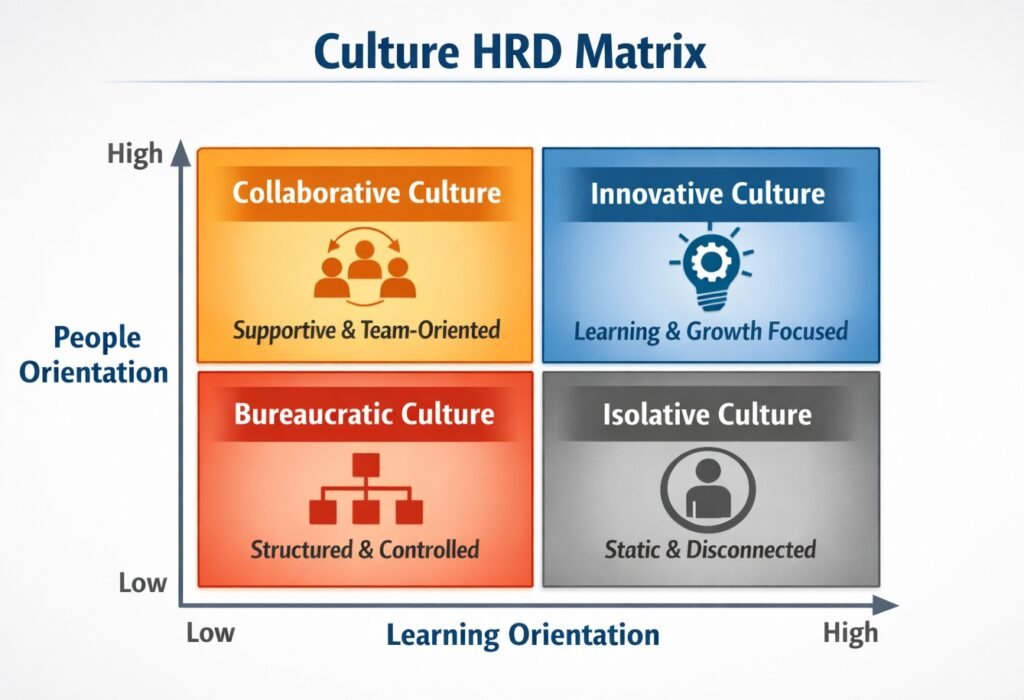
Dimensions of HRD Climate:
1. Proactivity
Proactivity refers to the extent to which employees take initiative, anticipate future needs, and act in advance rather than merely reacting to problems. In a proactive HRD climate, employees do not wait for instructions they identify skill gaps, seek learning opportunities, suggest improvements, and volunteer for challenging assignments. For an Indian IT company, proactivity means a developer learning a new programming language before the project demands it. Organizations measure proactivity through observations, self-reports, and instances of unsolicited initiatives. A proactive climate is supported by management encouragement, reward for initiative, and tolerance for well-intentioned mistakes. Without proactivity, HRD becomes top-down and reactive, with employees waiting for training to be assigned. Indian organizations like Infosys foster proactivity through learning budgets that employees can self-allocate. Proactivity is essential for organizational adaptability and continuous improvement. It transforms employees from passive recipients to active owners of their development.
2. Autonomy
Autonomy is the degree to which employees have freedom to make decisions about their work and development without excessive supervision or approval. In a high-autonomy HRD climate, employees choose which training to attend, how to schedule their learning, and which methods to use for problem-solving. For an Indian manufacturing plant, autonomy means machine operators can stop production if they detect quality issues, without waiting for supervisor permission. Autonomy is measured through employee surveys asking about decision-making freedom and manager surveys about delegation practices. A climate of autonomy requires trust from management, clear boundaries (what decisions are within employee control), and competence (employees can handle freedom). Without autonomy, employees become dependent, risk-averse, and disengaged. Indian organizations with bureaucratic hierarchies often stifle autonomy. Leading companies like Tata Motors have increased shop-floor autonomy, resulting in faster problem-solving and higher employee satisfaction. Autonomy fuels intrinsic motivation and learning initiative.
3. Trust
Trust is the belief that management and colleagues are reliable, honest, fair, and have good intentions. In a high-trust HRD climate, employees feel safe to admit mistakes, ask for help, share incomplete ideas, and try new approaches without fear of punishment or ridicule. For an Indian BPO, trust means an agent can admit not understanding a customer query without being penalized, enabling learning. Trust is measured through surveys asking about confidence in leadership, perceived fairness, and psychological safety. Building trust requires consistent behavior management keeping promises, fair treatment across employees, transparent communication, and non-punitive responses to honest errors. Without trust, employees hide mistakes (preventing learning), resist change (suspecting hidden agendas), and avoid seeking help (fearing exposure of incompetence). Indian organizations with high trust, like Tata Group, have lower attrition and faster change adoption. Trust is the foundation of a learning culture. It cannot be mandated but must be earned through sustained actions over time.
4. Openness
Openness refers to the willingness to share information, ideas, feedback, and feelings without fear of negative consequences. In an open HRD climate, communication flows freely upward, downward, and laterally. Employees give honest feedback to managers, managers share business challenges with teams, and colleagues exchange knowledge across departments. For an Indian IT project, openness means a junior developer can point out a flaw in a senior’s design without being rebuked. Openness is measured through feedback frequency, upward appraisal ratings, participation in knowledge sharing forums, and survey items about communication ease. Openness requires psychological safety, non-defensive leadership, and mechanisms like suggestion boxes, open-door policies, and skip-level meetings. Without openness, organizations suffer from information hoarding, gossip, rumors, and missed learning opportunities. Indian organizations with hierarchical, power-distance cultures struggle with openness. Companies like HCLTech have improved openness through transparent internal social platforms and town halls where leaders answer anonymous questions.
5. Collaboration
Collaboration is the extent to which employees work together across functions, teams, and levels to achieve shared goals and learn from each other. In a collaborative HRD climate, knowledge is shared freely, help is offered without expectation of return, and joint problem-solving is the norm. For an Indian manufacturing plant, collaboration means production and maintenance teams coordinating to reduce machine downtime, learning from each breakdown. Collaboration is measured through cross-functional project participation, peer recognition for helping behaviors, and survey items about teamwork. A collaborative climate requires structures that enable interaction (open offices, shared digital workspaces), rewards for team (not just individual) performance, and leadership modeling of collaboration. Without collaboration, organizations suffer from silos each department hoarding information, reinventing solutions, and blaming others for problems. Indian organizations like Tata Motors have formalized collaboration through cross-functional quality circles. Collaboration accelerates learning by pooling diverse perspectives and prevents repeated mistakes across units.
6. Support for Training
Support for training refers to organizational encouragement, resources, and recognition for employee learning and development. In a supportive climate, training needs are identified systematically, budgets are allocated, employees are given time off to attend programs, and learning is valued equally with production. For an Indian bank, support for training means branch managers release employees for week-long programs without penalty, and senior leaders speak at training events. Support is measured through training expenditure per employee, training days per year, participation rates, and manager survey items about prioritizing development. A supportive climate requires visible leadership commitment—CEOs attending training graduation ceremonies, managers coaching after training, and promotion criteria including learning behaviors. Without support, training is seen as a cost or a reward for high performers only, not as a right for all employees. Indian organizations like Infosys and TCS have dedicated training centers (Infosys Mysore campus, TCS BPS Academy) and mandated training hours annually. Support for training signals that development is truly valued.
7. Performance Appraisal Linkage
Performance appraisal linkage refers to the extent to which performance reviews are used for development rather than only for administrative decisions like pay and promotion. In a development-oriented climate, appraisals include discussion of strengths, improvement areas, career aspirations, and training needs not just a rating. For an Indian BPO, linkage means a low rating leads to a performance improvement plan with coaching and training, not just warning letters. Linkage is measured through survey items about appraisal fairness, development focus, and whether training identified in appraisals is actually provided. A linked climate requires managers trained in developmental appraisal, systems that track training needs identified during reviews, and follow-up mechanisms. Without linkage, appraisals cause anxiety and demotivation, employees hide weaknesses, and training is disconnected from actual performance gaps. Indian organizations like HDFC Bank integrate appraisal and training systems appraisal software flags skill gaps and suggests relevant e-learning modules. Linkage ensures HRD resources target real needs, not popular programs.
8. Reward for Learning
Reward for learning refers to organizational recognition and incentives for acquiring new skills, applying learning to work, and helping others learn. In a climate that rewards learning, employees receive certificates, badges, bonuses, promotions, or public acknowledgment for completing certifications, mastering new technologies, or mentoring juniors. For an Indian IT company, reward means an employee who completes cloud certification receives a bonus and is assigned to premium cloud projects. Reward for learning is measured through existence of learning incentives, utilization rates, and employee perceptions of whether learning leads to career advancement. A rewarding climate requires transparent criteria (what learning earns what reward), timely recognition (soon after achievement), and meaningful rewards (valued by employees). Without rewards, employees prioritize production over learning why spend weekend on certification if no one notices? Indian organizations like Wipro have point-based learning systems where points convert to gift vouchers. Rewards for learning reinforce that development is not optional but valued and expected.
9. Risk-Taking and Experimentation
Risk-taking refers to the organizational tolerance for employees trying new approaches, even if they fail, as long as lessons are learned. In an experimentation climate, employees are not punished for well-intentioned failures, pilot projects are encouraged, and post-mortems focus on learning rather than blame. For an Indian pharmaceutical R&D team, risk-taking means scientists can pursue high-risk, high-reward research directions without fear of career damage if experiments fail. Risk-taking is measured through number of pilot projects, employee willingness to propose new ideas, and management responses to failures (supportive or punitive). A climate that supports risk-taking requires clear boundaries (what risks are acceptable), learning reviews (analyzing failures systematically), and leadership modeling (managers admitting their own mistakes). Without risk-taking, employees stick to safe, proven methods, innovation stalls, and the organization becomes obsolete. Indian organizations like Tata Group have formal “Dare to Try” awards celebrating intelligent failures. Risk-taking is essential for organizational learning and adaptation in uncertain markets.
10. Top Management Commitment
Top management commitment refers to the visible, consistent engagement of senior leaders in HRD activities and values. In a committed climate, CEOs and department heads allocate resources, participate as trainers or mentors, attend learning events, and hold managers accountable for developing their teams. For an Indian manufacturing company, commitment means the plant manager spends one day per month teaching safety or leading a quality circle. Commitment is measured through leadership participation rates in training, percentage of HRD budget approved, and employee perceptions of whether senior leaders prioritize development. A committed climate requires leaders to walk the talk—not just approve training budgets but also model learning behaviors, ask about development in business reviews, and promote based on people development track record. Without top management commitment, HRD is seen as a peripheral activity, managers deprioritize training when production pressure rises, and budgets get cut first during downturns. Indian organizations like Tata Motors and Infosys have CEOs who champion learning, ensuring HRD remains strategic.
HRD Climate Measurement Tools:
1. Pareek and Rao HRD Climate Survey
Udai Pareek and T.V. Rao developed the most widely used HRD climate survey in the Indian context. The questionnaire contains 38 items covering eight dimensions: proactivity, autonomy, trust, openness, collaboration, support for training, performance appraisal linkage, and top management commitment. Each item is rated on a four-point or five-point Likert scale from “strongly disagree” to “strongly agree.” Example items: “Employees in this organization take initiative to learn new skills” and “Mistakes are treated as learning opportunities, not punishable offenses.” The survey takes 15-20 minutes to complete and is administered to employees across levels. Results are analyzed dimension-wise, and scores are compared to norms from similar organizations. The tool has been validated on Indian samples across manufacturing, IT, banking, and PSU sectors. Its strength is cultural relevance; weakness is that it does not capture newer dimensions like digital learning climate or psychological safety.
2. OCTAPACE Culture Profile
The OCTAPACE profile measures eight cultural dimensions that form the foundation of a positive HRD climate: Openness, Confrontation, Trust, Authenticity, Proactivity, Autonomy, Collaboration, and Experimentation. Developed by Udai Pareek, this tool contains 40 items (five per dimension) rated on a five-point scale. Example items: “People in this organization freely express their views” (Openness) and “People try out new ways of doing things” (Experimentation). The profile is administered to employees, and dimension scores are calculated and plotted on a radar chart for visual comparison. Indian organizations like L&T and Tata Steel have used OCTAPACE to diagnose culture and track changes after OD interventions. The tool takes 10-15 minutes to complete. Its strength is comprehensive coverage of HRD-enabling dimensions; weakness is that it measures perceptions, which may not fully reflect actual behaviors. OCTAPACE is both a diagnostic and a change monitoring tool.
3. HRD Climate Index (HRDCI)
The HRD Climate Index is a shorter, 20-item version of the Pareek and Rao survey, designed for quick assessments in organizations where time is limited. It covers five core dimensions: general climate (trust, openness), training support, performance appraisal linkage, career development support, and top management commitment. Each item is rated on a five-point scale, and the index is calculated as the average of all items. Example items: “My organization encourages employees to take up challenging assignments” and “Performance appraisals in this organization help identify training needs.” The HRDCI takes only 5-7 minutes to complete, making it suitable for pulse surveys or large-scale annual assessments. It has been used by Indian manufacturing and BPO organizations for benchmarking across units. Its strength is brevity and ease of administration; weakness is loss of nuance from the full 38-item version. The index provides a single score for easy comparison over time.
4. Learning Organization Survey (Watkins and Marsick)
Adapted for Indian contexts, this tool measures the extent to which an organization functions as a learning organization across seven dimensions: continuous learning, dialogue and inquiry, collaboration and team learning, embedded systems, empowerment, system connection, and strategic leadership. The full version has 55 items, with a shortened 21-item version commonly used in India. Example items: “In my organization, people openly discuss mistakes and learn from them” and “Leaders generally support requests for learning opportunities.” Respondents rate items on a five-point scale from “almost never” to “almost always.” Indian IT companies like Infosys and Wipro have used this tool to assess their learning cultures. The survey takes 15-20 minutes and provides dimension scores plus an overall learning organization quotient. Its strength is alignment with global learning organization literature; weakness is that some items assume Western workplace assumptions (e.g., high psychological safety) that may not hold in hierarchical Indian settings.
5. Psychological Safety Scale (Edmondson)
Amy Edmondson’s Psychological Safety Scale, adapted for Indian contexts, measures the extent to which employees feel safe to speak up, ask questions, admit mistakes, and offer ideas without fear of negative consequences. The scale has seven items rated on a seven-point scale from “strongly disagree” to “strongly agree.” Example items: “If you make a mistake in this organization, it is held against you” (reverse scored) and “People in this organization are comfortable bringing up problems and tough issues.” The tool is brief (3-5 minutes) and can be used standalone or as part of larger HRD climate assessments. Indian organizations like HCLTech have used this scale to diagnose psychological safety in teams. High psychological safety correlates with learning behavior, innovation, and lower attrition. The scale’s strength is its focus on a single, well-defined construct; weakness is that it does not capture other HRD climate dimensions like training support or career development. It is best used alongside broader HRD climate tools.
6. Focus Group Discussions (Qualitative Tool)
Focus group discussions are a qualitative method for measuring HRD climate by gathering small groups of employees (6-10 participants) to discuss their perceptions of development opportunities, learning culture, management support, and barriers to growth. A trained facilitator uses a semi-structured guide with questions like: “How does this organization support your learning?” and “What prevents you from applying new skills on the job?” Sessions last 60-90 minutes, are audio-recorded, transcribed, and analyzed thematically. For Indian organizations, focus groups capture nuances that surveys miss for example, subtle caste or gender biases in access to training, or informal networks that enable or block learning. Focus groups also allow probing and clarification. Their strength is depth and discovery of unexpected issues; weakness is that results are not statistically generalizable, and analysis is time-consuming. They are best used alongside quantitative surveys to interpret low scores and identify actionable improvement areas.
7. Exit Interview Analysis (HRD Climate Indicator)
Exit interviews, when systematically analyzed, provide indirect but valuable data about HRD climate. Departing employees often reveal whether lack of development opportunities, poor learning culture, unsupportive managers, or unfair performance appraisal systems contributed to their decision to leave. HR departments can code exit interview notes for themes related to HRD climate dimensions training quality, career progression, feedback culture, mentoring availability, and management commitment to development. For an Indian BPO, analysis of 100 exit interviews might reveal that 40 percent left due to “no learning opportunities” and 30 percent due to “appraisals not linked to training.” This data is real-time, low-cost (already collected), and specific to the organization. Weaknesses include that departing employees may exaggerate or withhold criticism, and the data is post-hoc (climate already damaged). Still, exit interview analysis complements proactive surveys. Indian organizations like Wipro regularly analyze exit data to identify HRD climate gaps.
8. 360-Degree Feedback for Climate Assessment
While typically used for individual development, 360-degree feedback aggregated across an organization reveals HRD climate patterns. When employees rate their managers on items like “My manager encourages my learning” or “My manager provides regular developmental feedback,” the aggregated scores indicate the quality of the HRD climate at the managerial level. For an Indian manufacturing company, 360-degree results might show that 60 percent of managers score low on “supports team members’ career development,” indicating a climate gap. The tool uses standardized questionnaires (20-30 items) completed by self, manager, peers, and direct reports. Aggregation across hundreds of employees provides statistically reliable climate data. Strength is that it captures actual behaviors, not just general perceptions; weakness is that 360-degree is resource-intensive and typically conducted only for managerial levels, not all employees. Indian organizations like Tata Motors use 360-degree data as one input for HRD climate assessment.
9. Training Evaluation Data as Climate Proxy
Training participation rates, completion rates, and post-training application data serve as behavioral indicators of HRD climate. High participation (e.g., 85 percent of eligible employees complete at least 40 hours of training annually) suggests a supportive climate. Low voluntary participation (employees only attend mandatory training) suggests climate issues lack of time, motivation, or management support. For an Indian IT company, analysis might show that training completion is high in some departments (90 percent) and low in others (40 percent), indicating climate variation by manager. Similarly, low application of learning (few employees report using new skills) suggests transfer climate problems. This data is objective (not perception-based) and already tracked in Learning Management Systems. Weakness includes that participation does not measure climate quality employees may attend but be disengaged. Still, training evaluation data is a low-cost, continuous climate monitoring tool. Indian organizations like TCS use dashboard tracking of learning metrics as real-time climate indicators.
10. Employee Engagement Survey (HRD Module)
Many Indian organizations administer annual employee engagement surveys that include specific modules or items on HRD climate. Standard engagement surveys (Gallup Q12, Aon Hewitt) include questions like “In the last year, I have had opportunities to learn and grow” and “My supervisor cares about my development.” These items, when analyzed separately, provide HRD climate scores. For an Indian bank, engagement survey results might show that 65 percent agree with “learning opportunities available” but only 40 percent agree with “training is applied on the job,” indicating a transfer climate gap. The strength of using engagement surveys is that data is already collected, benchmarked across industries, and linked to business outcomes (engagement scores predict productivity and retention). Weakness is that engagement surveys measure climate as one factor among many, not with the depth of dedicated HRD climate tools. Indian organizations like HDFC Bank analyze engagement survey sub-dimensions for HRD insights.
Indian Case Studies of HRD Climate:
1. Infosys: Positive HRD Climate for Learning
Infosys has long been recognized for its exceptional HRD climate, built on the foundation of continuous learning and employee development. The Infosys Global Education Center in Mysore, one of the largest corporate training facilities in the world, symbolizes top management commitment to HRD. New employees undergo 14-24 weeks of residential training before deployment. The company’s Lex platform provides thousands of online courses, and employees are encouraged to spend time on self-directed learning. The OCTAPACE culture—Openness, Confrontation, Trust, Authenticity, Proactivity, Autonomy, Collaboration, Experimentation is actively promoted. Employee surveys consistently show high scores on autonomy, support for training, and proactivity. Exit interview data reveals that lack of learning opportunities is rarely cited as a reason for leaving. Infosys demonstrates that a positive HRD climate requires sustained investment in infrastructure, leadership role modeling, and integration of learning into daily work.
2. Tata Motors: HRD Climate in Manufacturing
Tata Motors has cultivated a positive HRD climate across its manufacturing plants, transforming traditional shop-floor culture. The company introduced quality circles and small group activities where workers identify problems, propose solutions, and implement improvements. This requires high trust, autonomy, and collaboration—dimensions often weak in Indian manufacturing. Workers receive training in problem-solving tools (Pareto charts, fishbone diagrams) and are empowered to stop production lines if quality issues arise. The HRD climate survey administered annually shows improving scores on proactivity, risk-taking, and management commitment. Union cooperation was achieved through transparent communication and joint problem-solving. Apprenticeship programs (Kaushalya) provide structured skill development for young workers. Tata Motors demonstrates that even in traditional, unionized manufacturing settings, a positive HRD climate can be built through consistent management commitment, employee involvement, and visible rewards for learning and initiative.
3. HCLTech: Openness and Trust Transformation
HCLTech’s “Employees First, Customers Second” (EFCS) initiative dramatically transformed its HRD climate, particularly on openness and trust dimensions. Before EFCS, the climate was hierarchical, with employees hesitant to speak up or question managers. Vineet Nayar introduced the “U and I” platform where employees could publicly raise issues and expect management response within 48 hours. Smart Service Desks empowered frontline employees to approve their own training budgets and technology upgrades. The company conducted its first-ever upward feedback survey where employees rated managers, with results shared publicly. Trust scores improved significantly within two years. The HRD climate survey showed dramatic improvements on openness (employees felt safe to voice concerns), autonomy (decision-making authority), and proactivity (initiative without waiting for permission). HCLTech’s case proves that leadership commitment and structural changes (not just training programs) are essential for transforming HRD climate, especially in organizations with historically hierarchical cultures.
4. HDFC Bank: Performance Appraisal Linkage
HDFC Bank has built a strong HRD climate by linking performance appraisal directly to development, addressing a common weakness in Indian organizations where appraisals are seen as punitive. The bank’s performance management system includes mandatory career development discussions separate from rating conversations. Managers are trained to identify skill gaps during appraisals and create individual development plans. The HRIS automatically suggests relevant e-learning modules based on appraisal ratings. Employees report that training identified in appraisals is actually provided—a key HRD climate dimension often weak elsewhere. The bank’s internal HRD climate survey scores high on “performance appraisal linkage” and “support for training.” Exit interview data shows that “lack of development” is rarely cited. HDFC Bank demonstrates that a positive HRD climate requires not just training programs but systemic integration—appraisal systems that feed into training, managers held accountable for development, and technology that enables seamless linkage between performance gaps and learning resources.
5. Wipro: HRD Climate in BPO Sector
Wipro’s BPO division faced severe HRD climate challenges—high attrition, low trust, poor openness, and minimal support for training. Employees viewed training as wasted time that reduced their incentive earnings. Management responded with a multi-pronged HRD climate intervention. First, training was redesigned to be shorter, more relevant, and scheduled during paid time. Second, career paths were created—agents could become team leaders, quality analysts, or trainers after completing specified certifications. Third, managers were trained in coaching and feedback skills, and their performance appraisals included team development metrics. Fourth, an open-door policy and anonymous feedback system improved psychological safety. Within 18 months, the HRD climate survey showed significant improvements on trust, support for training, and proactivity. Attrition dropped from 40 percent to 25 percent. Wipro demonstrates that HRD climate can be transformed even in high-pressure BPO environments through visible career paths, manager accountability, and training that employees perceive as valuable, not punitive.
6. Steel Authority of India Limited (SAIL): PSU HRD Climate Challenges
SAIL, a large Indian public sector undertaking, illustrates HRD climate challenges common in PSUs. Despite having a central training institute and mandatory training days, the HRD climate was characterized by low proactivity (employees waited for orders), low autonomy (decision-making centralized), low risk-taking (fear of audit objections), and moderate trust (union-management relations varied by plant). Performance appraisals were seniority-based, not linked to development. Training was often treated as paid leave, not learning. However, some SAIL plants (Bokaro, Rourkela) developed better HRD climates through proactive union leaders and plant heads who championed learning. The case demonstrates that PSUs face structural barriers to positive HRD climate—bureaucratic rules, seniority-based promotions, audit culture that punishes risk-taking. Improvement requires not just HR interventions but systemic changes in governance and performance management. SAIL’s mixed experience shows that HRD climate is shaped by organizational context, not just HR department efforts.
7. Larsen & Toubro (L&T): OCTAPACE Implementation
L&T has systematically used the OCTAPACE framework to build and measure its HRD climate across diverse businesses—construction, manufacturing, technology, and defense. The company administers the OCTAPACE profile annually to thousands of employees, tracking dimension scores over time and across business units. Interventions are designed to address weak dimensions. For example, when openness scores dipped in the construction division, L&T introduced town halls with anonymous Q&A and cross-functional team meetings. When experimentation scores were low in the heavy engineering unit, management launched a “Dare to Try” fund for pilot projects. Business unit heads are held accountable for their OCTAPACE scores, and improvement targets are included in their performance appraisals. L&T demonstrates that HRD climate measurement must be linked to action—scores are not just for reporting but drive specific interventions. The case also shows that HRD climate varies by business unit, requiring tailored approaches rather than one-size-fits-all programs.
8. ITC Limited: HRD Climate in Diversified Conglomerate
ITC Limited has built a positive HRD climate across its diversified businesses—cigarettes, FMCG, hotels, paper, and agriculture. The company’s climate is characterized by high trust (employees speak openly), strong collaboration (cross-business projects common), and top management commitment (senior leaders teach in internal programs). The ITC Management Academy in Kolkata runs leadership programs for all managerial levels. Performance appraisals include a “people development” rating that affects manager bonuses. The HRD climate survey, adapted from Pareek and Rao, is administered bi-annually. A distinctive feature is ITC’s focus on social development (e.g., e-Choupal for farmers), which enhances the social relevance dimension of HRD climate—employees feel their work matters beyond profits. ITC demonstrates that HRD climate is shaped by organizational purpose, not just HR policies. Employees in businesses with strong social mission (agriculture, paper) report higher proactivity and commitment than those in pure commercial businesses, suggesting HRD climate varies by perceived meaningfulness of work.
