 by
Social security refers to a system of government-sponsored programs that provide financial protection and social assistance to individuals and families against economic risks such as old age, disability, sickness, unemployment, workplace injury, maternity, and loss of a breadwinner. It is based on the principle of social solidarity – the working population contributes today to support those who cannot support themselves (elderly, disabled, widowed, orphaned, unemployed). Social security schemes can be contributory (benefits linked to contributions made, e.g., Employee Provident Fund, pension schemes) or non-contributory (tax-funded benefits for the poor, e.g., old age pension, disability pension, food security). In India, social security covers organized sector workers (EPFO, ESI) and increasingly unorganized sector workers (Pradhan Mantri Shram Yogi Maan-dhan, PMJJBY, PMSBY, Atal Pension Yojana). The Constitution of India (Directive Principles) directs the State to make provision for social security.
Objectives of Social Security:
1. Providing Income Security in Old Age
The primary objective is to ensure that elderly persons who are no longer able to work have a regular income to meet basic needs – food, shelter, healthcare, and clothing. Old age leads to reduced earning capacity (retirement) or complete loss of income. Without social security, elderly persons would depend entirely on family members (children, relatives) or fall into poverty. Pension schemes (EPFO, NPS, Atal Pension Yojana, old age pension under NSAP) provide monthly income. This objective respects the dignity of the elderly, reducing their financial dependence on others and preventing destitution in old age.
2. Providing Income Security in Case of Disability
Persons with physical or mental disabilities (congenital or acquired through accident, illness, or occupational injury) have reduced or zero earning capacity. Social security provides disability pensions or benefits to replace lost income. In India, the Employee State Insurance (ESI) scheme provides disability benefits for work-related injuries. The National Social Assistance Programme (NSAP) provides disability pensions for those below the poverty line. The Rights of Persons with Disabilities Act, 2016, mandates government support. This objective ensures that disabled persons are not relegated to begging or institutionalization, enabling them to live with dignity.
3. Providing Maternity and Paternity Benefits
Working women lose income during pregnancy, childbirth, and post-natal recovery due to time away from work (maternity leave). Social security provides maternity benefits (paid leave or cash payment) to replace lost wages. The Maternity Benefit Act, 1961, mandates paid leave of 26 weeks for women in organized sector establishments. The ESI scheme provides maternity benefits (cash payments for up to 26 weeks) for insured women. Some schemes recognize paternity benefits (limited). This objective protects the health of mother and child, enables breastfeeding, reduces infant mortality, and prevents women from losing their jobs or falling into poverty due to childbirth.
4. Providing Medical Care and Sickness Benefits
Illness (short-term or long-term) leads to loss of income (inability to work) and high medical expenses (hospitalization, medicines, doctor fees). Social security provides cash benefits (sickness benefit – payment during absence from work) and also access to medical care (free or subsidized healthcare). The ESI scheme provides both – cash sickness benefit (up to 91 days per year) and medical care through ESI hospitals and dispensaries. The Rashtriya Swasthya Bima Yojana (now part of Ayushman Bharat) provides health insurance for BPL families. This objective prevents medical poverty – families falling below the poverty line due to a single illness.
5. Providing Support to Survivors (Widows and Orphans)
When a breadwinner dies (due to accident, illness, or other cause), dependent family members (widow, widower, minor children, dependent parents) lose their source of income. Social security provides survivor benefits – monthly pension or lump sum payment – to the dependents. The Employee Provident Fund (EPFO) provides family pension under the Employees’ Pension Scheme (EPS). The National Social Assistance Programme (NSAP) provides widow pension (for BPL widows). This objective prevents the surviving family from falling into destitution, ensures children can continue education, and provides some financial stability during the period of grief and adjustment.
6. Providing Unemployment Benefits
Workers who lose their jobs involuntarily (retrenchment, closure of establishment, layoff) face loss of income while searching for alternative employment. Social security provides unemployment benefits (cash payments for a limited period) to tide over the gap. In India, the ESI scheme provides unemployment allowance (Rajiv Gandhi Shramik Kalyan Yojana) for insured workers who lose employment. However, comprehensive unemployment insurance is limited in India compared to European countries. Some state government schemes provide unemployment benefits for registered unemployed persons (e.g., Rajasthan, West Bengal). This objective provides a safety net, allowing workers time to find suitable employment without accepting exploitative wages or selling assets.
7. Reducing Poverty and Inequality
Social security transfers income from the working population (and employers, and government tax revenues) to those who cannot work or have low income – elderly, disabled, widows, orphans, unemployed. This reduces poverty among vulnerable groups. It also reduces inequality by providing a minimum standard of living to those at the bottom of the income distribution. Studies show that old age pensions in India have reduced poverty among the elderly by 20-30%. This objective is broader than individual protection – it serves social justice and social cohesion. A society that protects its vulnerable members is more stable, less prone to crime and unrest, and more productive because workers are less anxious about risks.
8. Encouraging Savings and Formal Employment
Social security schemes (especially contributory ones like EPFO, ESI, NPS) encourage workers to save regularly for their own future needs (retirement, medical, housing). The employer also contributes, and the government may provide tax benefits (Section 80C for EPF, Section 80CCD for NPS). This reduces the future burden on the state (pension spending) because workers finance their own security. Additionally, mandatory social security coverage incentivizes formal employment – workers prefer jobs that offer EPF, ESI, and pension benefits, pushing employers to formalize. This objective links social security with economic development, increasing the national savings rate and broadening the tax base.
9. Stabilizing Aggregate Demand During Economic Shocks
During economic recessions or crises (e.g., COVID-19 lockdowns), unemployment rises, and incomes fall. Without social security (unemployment benefits, food transfers, cash transfers), households drastically cut spending, worsening the recession (deflationary spiral). Social security payments (unemployment benefits, pensions, food subsidies, direct cash transfers like PM-KISAN) put purchasing power in the hands of those who will spend it immediately (high marginal propensity to consume). This stabilizes aggregate demand, supporting businesses and jobs, and shortening the recession. This objective is macroeconomic – social security acts as an automatic stabilizer, reducing the amplitude of economic cycles.
10. Fulfilling Constitutional and International Obligations
The Constitution of India, under Directive Principles of State Policy (Article 41), directs the State to provide social security to citizens in cases of unemployment, old age, sickness, disablement, and other cases of undeserved want. International commitments include: International Labour Organization (ILO) conventions (Social Security (Minimum Standards) Convention, 1952, No. 102), Sustainable Development Goals (SDG 1.3 – implement nationally appropriate social protection systems and measures for all). This objective is about state obligation and human rights. Social security is not charity; it is a legal right for those covered. Fulfilling these obligations enhances the state’s legitimacy and international standing.
Types of Social Security in India:
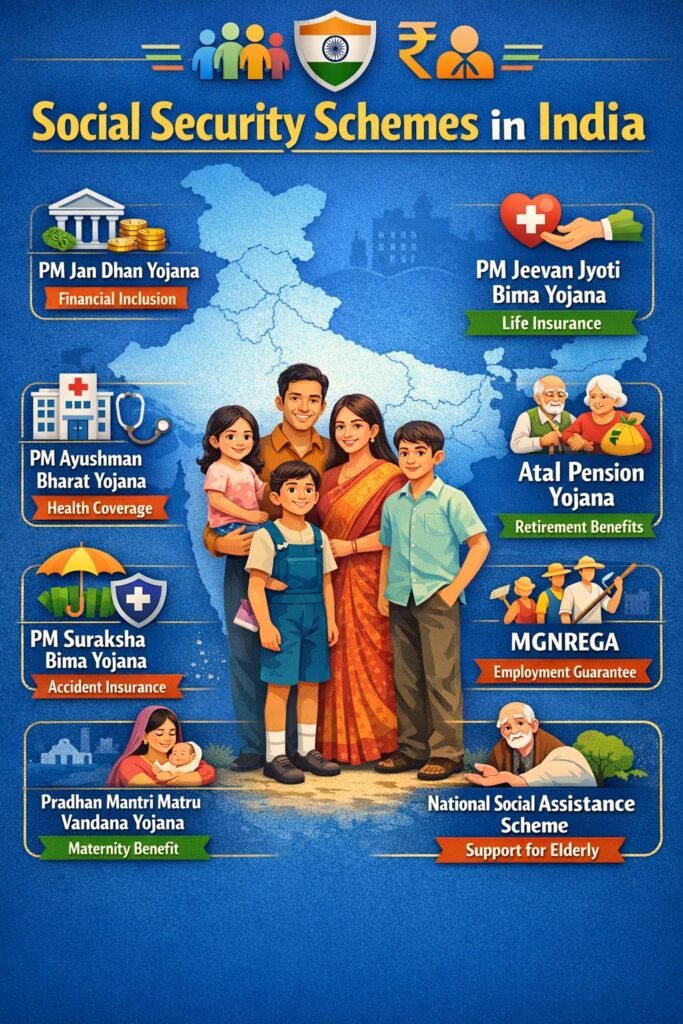
1. Employee Provident Fund (EPF)
The Employee Provident Fund (EPF) is a mandatory contributory retirement savings scheme for employees in establishments with 20 or more workers, governed by the Employees’ Provident Funds and Miscellaneous Provisions Act, 1952. Both employee (12% of basic wages) and employer (12% of basic wages, of which 3.67% goes to EPF and 8.33% to EPS) contribute. The accumulated corpus (with interest, currently around 8-8.5% per annum) is payable at retirement (age 58) or resignation (after 2 months unemployment). Partial withdrawals are allowed for specific purposes – house purchase, medical treatment, education, marriage. EPF is administered by the Employees’ Provident Fund Organisation (EPFO) under the Ministry of Labour and Employment.
2. Employees’ Pension Scheme (EPS)
The Employees’ Pension Scheme (EPS) is a contributory pension scheme for employees in establishments covered under EPF. The employer contributes 8.33% of the employee’s basic wages (subject to a pensionable salary cap of ₹15,000 per month) towards EPS. The employee makes no separate contribution. Upon retirement (age 58), the employee receives a monthly pension calculated based on pensionable service (years of service) and pensionable salary (average of last 60 months). The formula: (Pensionable Salary × Pensionable Service) ÷ 70. Minimum pension is ₹1,000 per month (with government topping up). Early pension at age 50 with reduced amount. EPS is administered by EPFO.
3. Employee State Insurance (ESI)
Employee State Insurance (ESI) is a comprehensive social security scheme for employees in establishments with 10 or more workers (in some states, 20 or more). It provides medical care, sickness benefit, maternity benefit, disability benefit, dependent benefit (family pension for dependents after death of insured), and funeral expenses. Employees contribute 0.75% of wages, employers contribute 3.25% (total 4%). ESI covers employees with wages up to ₹21,000 per month (₹25,000 for persons with disability). Medical care is provided through ESI hospitals, dispensaries, and panel clinics. Cash benefits are paid during periods of absence from work due to sickness (up to 91 days per year), maternity (26 weeks), or disablement. ESI is administered by the Employees’ State Insurance Corporation (ESIC) under the Ministry of Labour and Employment.
4. Pradhan Mantri Jeevan Jyoti Bima Yojana (PMJJBY)
PMJJBY is a government-sponsored, low-cost life insurance scheme for individuals between 18 and 50 years (upper age extended to 65 for some coverage). The scheme provides a life cover of ₹2 lakh (lump sum payment to nominee) in case of the insured’s death due to any cause. The annual premium is ₹436 (as of 2025), auto-debited from the bank account (with the account holder’s consent). The scheme is offered through participating banks (public, private, rural, cooperative). Eligibility: bank account holder with Aadhaar linkage. Individuals can enroll at any time, but coverage is on a yearly renewal basis (June 1 to May 31). PMJJBY covers death due to accident also (no extra premium). Government fully guarantees the scheme.
5. Pradhan Mantri Suraksha Bima Yojana (PMSBY)
PMSBY is a government-sponsored, low-cost accident insurance scheme for individuals between 18 and 70 years. The scheme provides accidental death and disability cover: ₹2 lakh for death or total permanent disability (loss of both eyes, both hands, both feet, or one eye and one hand), and ₹1 lakh for partial permanent disability (loss of one eye or one hand or one foot). The annual premium is ₹20, auto-debited from the bank account. The scheme is offered through participating banks. Individuals can enroll at any time, with coverage on a yearly renewal basis (June 1 to May 31). PMSBY complements PMJJBY (which covers death from all causes) by specifically covering accident-related death and disability.
6. Atal Pension Yojana (APY)
APY is a government-backed pension scheme for unorganized sector workers (not covered by EPFO, ESI, or any other statutory pension scheme). Any Indian citizen aged 18-40 with a bank account can join. The subscriber chooses a monthly pension amount (₹1,000, ₹2,000, ₹3,000, ₹4,000, or ₹5,000) upon retirement at age 60. The required monthly contribution increases with later joining age (younger subscribers pay lower contributions over a longer period). The government contributes 50% of the subscriber’s contribution (or ₹1,000 per year, whichever is lower) for the first 5 years (for eligible subscribers). After retirement, the pension is guaranteed for life; spouse receives 50% pension; upon death of both, the accumulated corpus is returned to the nominee. APY is administered by the Pension Fund Regulatory and Development Authority (PFRDA) through banks.
7. National Pension System (NPS)
NPS is a voluntary, defined contribution pension scheme open to all Indian citizens (including self-employed and unorganized sector). Subscribers contribute regularly to a pension account (Tier I – mandatory, restricted withdrawal; Tier II – voluntary, flexible withdrawal). The contributions are invested in a mix of equity, corporate bonds, and government securities (based on the subscriber’s choice of asset allocation). At retirement (age 60), the subscriber can withdraw 60% of the corpus tax-free and must use the remaining 40% to purchase an annuity (which provides a regular pension). Partial withdrawals (up to 25% of contributions) are allowed for specified purposes after 3 years or 10 years depending on the purpose. NPS offers tax benefits under Section 80CCD(1) (up to ₹1.5 lakh) and additional deduction of up to ₹50,000 under Section 80CCD(1B). NPS is administered by PFRDA.
8. National Social Assistance Programme (NSAP)
NSAP is a centrally-sponsored, non-contributory social security scheme (tax-funded, no premium) for poor and vulnerable households below the poverty line (BPL). It has five components: (a) Indira Gandhi National Old Age Pension (IGNOAPS) – ₹200-500 per month for persons aged 60+ (higher for 80+); (b) Indira Gandhi National Widow Pension (IGNWP) – ₹200-500 per month for widows aged 40+; (c) Indira Gandhi National Disability Pension (IGNDP) – ₹200-500 per month for persons with severe/multiple disabilities aged 18+; (d) National Family Benefit Scheme (NFBS) – lump sum of ₹20,000 to BPL family on death of primary breadwinner; (e) Annapurna Scheme – 10 kg of free food grains per month for destitute aged 65+ not receiving old age pension. NSAP is implemented by state governments with central funding.
9. Pradhan Mantri Shram Yogi Maan-dhan (PMSYM)
PM-SYM is a voluntary, contributory pension scheme for unorganized sector workers – street vendors, domestic workers, construction workers, weavers, fishermen, cobblers, washermen, rickshaw pullers, drivers, agricultural workers, beedi workers. Workers aged 18-40 with monthly income up to ₹15,000 can join. The subscriber contributes a small amount per month (₹55-200 based on age); the central government contributes the same amount. At retirement (age 60), the subscriber receives a monthly pension of ₹3,000 (assured, not market-linked). Spouse receives 50% pension after the subscriber’s death (if no child). Upon death of both, the accumulated corpus is returned to the nominee. PM-SYM is administered by the Ministry of Labour and Employment through Life Insurance Corporation (LIC).
10. Maternity Benefit (under ESI and Maternity Benefit Act)
Maternity benefits in India are provided through two channels. For organized sector workers covered under ESI (wage up to ₹21,000 per month), paid maternity leave is 26 weeks (6 weeks before expected delivery, 20 weeks after). The payment is a cash benefit equal to the average daily wage, payable for the entire leave period. For workers not covered under ESI (e.g., small establishments with less than 10 employees), the Maternity Benefit Act, 1961, applies – it mandates 26 weeks paid leave for women who have worked at least 80 days in the preceding 12 months, with the employer responsible for payment. For women with two or more children, 12 weeks leave. The Central Government also provides wage compensation for BEEDI workers, NULM workers, and others through separate schemes.
11. Unorganized Workers’ Social Security (PM Jan Arogya and Others)
Unorganized workers (constituting over 90% of India’s workforce – agricultural, construction, domestic, street vending, mining, etc.) are covered under multiple schemes: (a) Ayushman Bharat Pradhan Mantri Jan Arogya Yojana (AB-PMJAY) – health insurance cover of ₹5 lakh per family per year for treatment in empaneled hospitals, covering over 10 crore poor families (identified under Socio-Economic Caste Census). (b) Pradhan Mantri Jan Dhan Yojana (PMJDY) – zero-balance bank accounts with RuPay debit card and accident insurance of ₹2 lakh (with PMSBY). (c) Pradhan Mantri Jeevan Jyoti Bima Yojana (PMJJBY) – life insurance cover of ₹2 lakh. (d) National Family Benefit Scheme (NFBS) – lump sum of ₹20,000 to BPL family on death of primary breadwinner. These schemes provide a basic social security floor for the otherwise uncovered unorganized sector.
12. State-Specific Social Security Schemes
Various state governments in India have their own social security schemes supplementing central schemes. Examples: (a) Rajasthan’s Bhamashah Swasthya Bima Yojana (now replaced by PMJAY but with additional top-up coverage), (b) West Bengal’s Swasthya Sathi health insurance scheme (₹5 lakh cover per family), (c) Tamil Nadu’s Chief Minister’s Comprehensive Health Insurance Scheme (up to ₹5 lakh), (d) Delhi’s old age pension (higher rates than central NSAP), (e) Telangana’s Rythu Bandhu (income support for farmers – ₹4,000 per acre per season), (f) Odisha’s KALIA (Krushak Assistance for Livelihood and Income Augmentation – financial assistance to small and marginal farmers). State schemes vary significantly in coverage, benefits, and funding. Eligibility is typically based on state domicile and income criteria. Many state schemes operate alongside central schemes (with the state government filling gaps or providing top-up).
Problems Social Security in India:
1. Limited Coverage (Only Organized Sector)
Social security schemes in India primarily cover organized sector workers – government employees, public sector undertakings, and private establishments with 10 or more workers (ESI) or 20 or more workers (EPFO). Over 90% of India’s workforce is in the unorganized sector – agricultural labourers, construction workers, domestic workers, street vendors, beedi workers, weavers, fishermen, rickshaw pullers, and gig workers (Zomato, Swiggy, Uber, Ola). These workers have no statutory coverage under EPFO, ESI, or EPS. Even where schemes exist (PMJJBY, PMSBY, APY, PM-SYM), enrollment is voluntary and penetration is low. The vast majority remain outside any formal social security net, leaving them vulnerable to poverty in old age, illness, disability, or job loss.
2. Low Benefit Amounts
Even for those covered, benefit amounts are inadequate to meet basic needs. NSAP old age pension is only ₹200-500 per month (depending on state) – insufficient for food, medicine, and shelter. APY pension ranges from ₹1,000-5,000 per month, but contributions start at age 18; many cannot afford regular contributions over 42 years. PMJJBY and PMSBY provide only ₹2 lakh cover – a single hospitalization or accident can exceed this. ESI sickness benefit is 70% of average daily wages but capped at wage limit of ₹21,000. EPS monthly pension is calculated on ₹15,000 cap – a worker retiring after 30 years of service gets only about ₹6,400 per month (15,000 × 30 ÷ 70). Low benefits fail to prevent poverty.
3. Poor Coverage of Migrant Workers
Migrant workers (inter-state or intra-state) face unique social security challenges. EPFO and ESI are establishment-based – if a worker moves from one employer to another (or from one state to another) without formal transfer of accounts, contributions may be lost (or left unclaimed). Many migrant workers are in casual or contract employment, not covered under EPFO/ESI because the employer does not declare them. Even for covered workers, benefits are not portable across states easily – ration cards (PDS) are state-specific; health insurance (AB-PMJAY) requires enrollment in the state of origin; the worker in destination state may not have access. During COVID-19 lockdowns, millions of migrants lost income and had no unemployment benefit or social security, exposing the system’s failure.
4. Low Awareness and Low Enrollment
A large proportion of eligible individuals are not enrolled in voluntary social security schemes (PMJJBY, PMSBY, APY, PM-SYM, NPS). Reasons include: low financial literacy (not understanding the product, mistrust of insurance/pension schemes), lack of awareness (not knowing schemes exist, not understanding enrollment process), apathy (immediate needs outweigh long-term benefits), inability to pay regular premiums (APY requires contributions for decades, but daily wage workers have irregular income), and lack of last-mile outreach (banks in rural areas may not actively promote these schemes). Even for mandatory schemes (EPFO, ESI), many eligible workers are not enrolled because employers evade coverage (keep employee count below threshold, treat workers as contractors). Low enrollment defeats the purpose of social protection.
5. Implementation Gaps and Administrative Delays
Even where coverage exists, implementation is poor. EPFO claims settlement takes months (often 6-12 months for final withdrawal), causing hardship to retiring workers. ESI medical care suffers from shortages of doctors, medicines, and equipment in ESI hospitals; insured workers often prefer private treatment (paid out-of-pocket). NSAP pensions are delayed or stopped due to lack of timely life certificate submission (digital Jeevan Pramaan not accessible to all), database errors, or corruption at panchayat level. AB-PMJAY claims are sometimes denied (documentation issues, hospital not empaneled, treatment not covered). Migrant workers have difficulty accessing benefits in destination states. Grievance redressal is weak – Insurance Ombudsman handles only disputes with insurers, but many social security schemes are not insurance (e.g., NSAP).
6. Inadequate Coverage of Gig and Platform Workers
Gig workers (Zomato, Swiggy, Uber, Ola, Urban Company, Amazon Flex, Flipkart) and platform workers are a rapidly growing segment of India’s workforce, but they are not covered under traditional social security laws because they are not “employees” (classified as independent contractors). Neither EPFO nor ESI applies. They have no employer contribution towards social security. Some platforms offer accident insurance (limited, low coverage), but no pension, no health insurance, no maternity benefit, no unemployment benefit. The Social Security Code, 2020, recognized gig and platform workers and proposed a social security fund (contributions from platforms, aggregators, workers), but implementation is incomplete as of 2025. This large and growing segment remains outside the formal social security net.
7. Fragmented and Overlapping Administration
Social security in India is administered by multiple ministries and agencies – Ministry of Labour (EPFO, ESI, PM-SYM), Ministry of Finance (PMJJBY, PMSBY, APY through banks), Ministry of Rural Development (NSAP), Ministry of Health (AB-PMJAY), and PFRDA (NPS). Each has separate eligibility criteria, enrollment processes, contribution rates, benefit formulas, and grievance redressal. A worker may be eligible for multiple schemes but must enroll separately (different forms, different documentation). Workers are confused about which scheme applies to them. Coordination between ministries is poor – databases are not integrated (EPFO member might also be eligible for NSAP, but there is no cross-check). This fragmentation increases administrative costs, delays benefits, and leads to duplication or exclusion.
8. Inadequate Funding and Fiscal Constraints
Non-contributory schemes (NSAP, AB-PMJAY subsidies) are funded entirely by tax revenues (central and state governments). India’s social security spending as a percentage of GDP is low (approximately 1-2% of GDP) compared to developed countries (15-25% of GDP). Underfunding leads to low benefit amounts (₹200-500 per month pension), coverage gaps (only BPL families covered, not all poor), and rationing (cap on number of beneficiaries per state, waiting lists). The government faces competing demands – infrastructure, defense, education, health, subsidies (food, fertilizer, fuel). Expanding social security requires either increasing taxes (politically difficult) or reducing other spending (also difficult). The fiscal constraint means that India’s social security will remain low-benefit and narrow-coverage for the foreseeable future.
9. Exclusion of Self-Employed and Small Farmers
Self-employed individuals (shopkeepers, traders, professionals, freelancers) and small farmers are not covered by any mandatory social security scheme. They can voluntarily join NPS (pension), PMJJBY (life), PMSBY (accident), and AB-PMJAY (health), but many do not due to low awareness or income constraints. They have no employer to contribute towards EPF or ESI. They have no unemployment benefit. They have no maternity benefit (unless they purchase separate health insurance with maternity cover). For small farmers, crop insurance (PMFBY) is available but voluntary (many do not enroll due to premium cost or complexity). Thus, a large segment of the working population (self-employed and farmers) relies on family support, savings, or informal credit, with no formal social security safety net.
10. Lack of Unemployment Insurance
India has no comprehensive unemployment insurance scheme for workers who lose jobs involuntarily (retrenchment, closure of establishment, layoff, resignation due to health or family reasons). ESI provides unemployment allowance (Rajiv Gandhi Shramik Kalyan Yojana) only for insured workers (wage up to ₹21,000) who are retrenched – the benefit duration is limited (up to 2 years) and amount is about 50% of average daily wages. There is no unemployment benefit for unorganized sector workers, self-employed, gig workers, or organized sector workers not covered by ESI (e.g., those earning above ₹21,000). During COVID-19, millions of workers lost income; the government provided only ad-hoc relief (Pradhan Mantri Garib Kalyan Yojana – free food grains, cash transfer), not a regular unemployment insurance system. This is a major gap.
11. Portability Issues
Workers change jobs, locations, and sectors multiple times in their career. EPFO accounts can be transferred (through online claim), but many workers do not transfer (leaving small balances idle; eventually forfeited after 3 years? – EPF rules: if no contribution for 3 years and no transfer, account becomes inactive; interest stops but balance remains). ESI coverage is not portable across employers if the new employer is not covered by ESI (or if wage exceeds ₹21,000). Ration cards (PDS) are state-specific – a worker moving from Bihar to Delhi loses access to subsidized food. AB-PMJAY covers hospitalization but is state-specific (worker from UP in Maharashtra may not have access). Portability failures lead to loss of benefits, disincentives to formal employment, and hardship for migrant workers.
12. Gender Gaps
Social security coverage for women is lower than for men due to: lower labour force participation rate (women are more likely to be in unpaid care work, not in paid employment eligible for EPFO/ESI), lower wages (women earn less, so less contribution accumulation), career breaks (maternity, child-rearing, elderly care – breaks reduce years of service for EPS pension calculation), and informal sector concentration (domestic workers, home-based workers – not covered under EPFO/ESI). Maternity benefits apply only to women in formal employment (or under ESI). Unorganized sector women have no paid maternity leave. Widow pension (NSAP) is available only below poverty line (BPL). Gender-neutral schemes (PMJJBY, PMSBY, APY) do not address the structural barriers women face in accessing employment and, thereby, social security.
