 by
by The Project Management Life Cycle (PMLC) is a structured framework that divides a project’s journey into distinct, sequential phases from start to finish. It provides a standardized pathway for initiating, planning, executing, monitoring, controlling, and closing any project. Each phase has specific deliverables, processes, and approval points (gateways). The number of phases can vary (typically 4 to 6), but common models include Initiation, Planning, Execution, Monitoring & Control, and Closure. The life cycle ensures disciplined progress, clear accountability, and systematic risk management. It applies to all industries construction, IT, events, or research. Understanding the PMLC is fundamental because it transforms an abstract idea into a measurable, controllable, and repeatable project outcome.
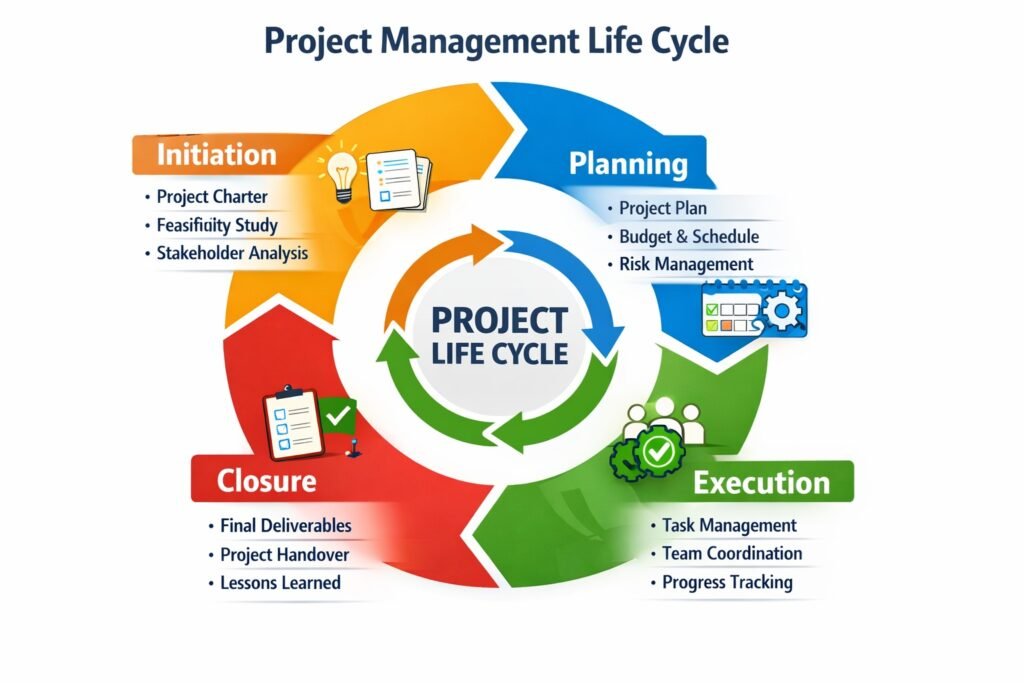
Phases of the Project Management Life Cycle:
1. Initiation Phase
The initiation phase defines the project at a high level and secures authorization to proceed. Key activities include developing the Project Charter, identifying stakeholders, conducting a feasibility study, and appointing the project manager. The Project Charter formally authorizes the project, defines high-level scope, objectives, key milestones, budget, and risks. Stakeholder identification lists all individuals or groups affected by or affecting the project. The phase ends with a Gate Review or Kill Point, where the sponsor decides whether to approve funding and move to planning. Advantages include clear authorization, avoidance of wasted resources on invalid projects, and early risk awareness. Without proper initiation, projects suffer from scope creep, unclear authority, and stakeholder conflicts later. This phase consumes relatively low cost but has high impact on eventual success.
2. Planning Phase
The planning phase develops a detailed roadmap for executing and controlling the project. Activities include creating the Scope Statement, Work Breakdown Structure (WBS), schedule (Gantt/CPM), budget, quality plan, risk register, communication plan, and procurement plan. The Project Management Plan integrates all subsidiary plans. Baseline definitions for scope, schedule, and cost are established to measure performance later. Resource planning assigns team members, equipment, and materials. The planning phase is iterative—as new information emerges, plans are refined. Advantages include reduced uncertainty, efficient resource allocation, and clear performance metrics. Poor planning is the leading cause of project failure. This phase consumes 10-20% of project effort but determines 80% of outcomes. Approval of the Project Management Plan authorizes execution.
3. Execution Phase
The execution phase involves performing the work defined in the project management plan to deliver the product, service, or result. Activities include directing team members, managing communications, conducting procurements, performing quality assurance, and implementing approved changes. The project manager assigns tasks, coordinates resources, motivates the team, and manages stakeholder expectations. Deliverables are produced incrementally or as a final output. Execution generates most of the project budget (60-80%) and consumes maximum resources. Advantages include visible progress, tangible outputs, and team momentum. Challenges include managing conflicts, handling unplanned issues, and maintaining quality under schedule pressure. Execution relies heavily on planning quality—poor plans lead to rework and delays. Regular team meetings, status reports, and change control boards operate during this phase.
4. Monitoring and Controlling Phase
Monitoring and controlling runs concurrently with execution. It involves tracking, reviewing, and regulating progress against the project management plan. Activities include measuring actual vs. planned scope, schedule, cost, and quality; calculating Earned Value Metrics (CPI, SPI); managing change requests; updating risk registers; and conducting inspections or audits. Preventive actions correct deviations before they become failures; corrective actions fix issues already occurred. Change control ensures only approved modifications impact baselines. Advantages include early detection of variances, objective performance data, and informed decision-making. Without monitoring, projects drift into cost overruns and schedule delays unnoticed. Key outputs include work performance reports, change requests, and updated project documents. This phase provides the feedback loop essential for adaptive control and stakeholder confidence.
5. Closure Phase
The closure phase formally completes the project and transfers deliverables to the customer or operations team. Activities include obtaining final acceptance or sign-off, releasing resources, closing contracts with suppliers, settling final payments, and completing post-project reviews (lessons learned). Administrative closure involves archiving all project documents, updating organizational process assets, and reporting final performance (planned vs. actual). Team members are reassigned, and the project manager submits a closure report. Advantages include preventing “never-ending” projects, capturing knowledge for future projects, and satisfying contractual obligations. Incomplete closure leads to unpaid invoices, unresolved disputes, and lost learning. For Indian government or large corporate projects, formal closure is mandatory for audit compliance. This phase marks the transition from project to business-as-usual operations.
| Phase | Key Activities |
|---|---|
| 1. Initiation | – Develop Project Charter – Identify key stakeholders – Conduct feasibility study (technical, economic, legal) – Appoint project manager – Perform high-level risk assessment – Obtain project authorization/approval from sponsor |
| 2. Planning | – Define detailed scope statement – Create Work Breakdown Structure (WBS) – Develop schedule (Gantt chart, CPM/PERT) – Estimate costs and prepare budget – Identify risks and prepare risk register – Plan quality, communication, resources, and procurement – Obtain approval of Project Management Plan |
| 3. Execution | – Direct and manage team work – Conduct kick-off meeting – Perform quality assurance activities – Manage communications with stakeholders – Conduct procurements (vendor selection, contracts) – Implement approved changes – Produce project deliverables |
| 4. Monitoring & Controlling | – Measure actual vs. planned performance (Earned Value Management) – Track schedule variance (SV) and cost variance (CV) – Manage change requests through Change Control Board – Update risk register and implement risk responses – Perform quality control inspections – Generate work performance reports – Conduct regular status reviews and audits |
| 5. Closure | – Obtain final acceptance/sign-off from customer – Release project resources (team, equipment) – Close contracts with suppliers and vendors – Complete lessons learned document – Archive all project documents – Prepare and submit final project closure report – Celebrate team success and reassign members |

One thought on “Project Management Life Cycle”