 by
1. European Currency Options
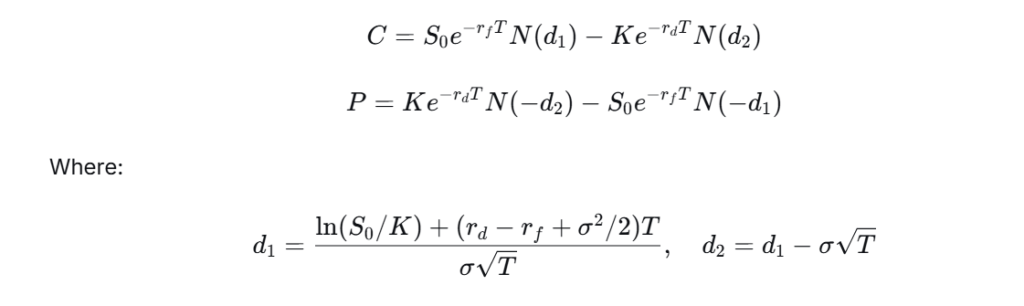
European currency options can be exercised only at expiration, not before. Most exchange-traded currency options (e.g., CME, NSE) and many OTC options are European-style. The restriction simplifies valuation using the Garman-Kohlhagen model. Early exercise is rarely optimal for currency options unless interest rate differentials are extreme (violating covered interest parity). European options are cheaper than American options (same terms) because the seller has less obligation risk. They are widely used for hedging known future cash flows (e.g., a receivable due on a specific date). The holder cannot capture early favorable moves, but this limitation is usually irrelevant for corporate treasuries matching exact payment dates.
2. American Currency Options
American currency options can be exercised at any time up to and including expiration. They are common on some exchange-traded currency options (e.g., CME offers American-style on certain pairs) and OTC markets. Early exercise may be optimal when interest rate differentials create a carry advantage. For example, exercising a call on a high-interest currency early allows the holder to earn interest. American options command a higher premium than European options (same terms) due to the additional exercise flexibility. They are useful when the exact timing of the underlying cash flow is uncertain or when the holder wants to capture arbitrage opportunities from interest rate differentials. Valuation requires binomial trees or other numerical methods.
3. Barrier Currency Options
Barrier options are exotic OTC currency options that become active (knock-in) or inactive (knock-out) when the spot exchange rate reaches a predetermined barrier level. Down-and-out put: a put that ceases to exist if the spot falls below a barrier. Up-and-in call: a call that only comes into existence if the spot rises above a barrier. Barrier options are cheaper than vanilla options because the payoff is conditional. Corporations use them to hedge contingent exposures (e.g., a foreign currency tender that may or may not win). The risk is “barrier risk”—the option may knock out just before a favorable move. Pricing requires sophisticated models (finite difference, Monte Carlo). They are popular in OTC markets.
4. Asian Currency Options
Asian options (average rate options) have payoffs based on the average exchange rate over a period, not the spot rate at a single point. An average rate call pays max(average rate – strike, 0). An average strike call pays max(spot – average rate, 0). Asian options are cheaper than vanilla options because averaging reduces volatility (smoothing effect). They are ideal for corporates with regular, ongoing foreign currency cash flows (e.g., monthly exports over a quarter). The averaging mechanism reduces the risk of manipulation at a single fixing date. Pricing Asian options is complex (no closed-form solution for arithmetic averages; geometric average has closed form). They are exclusively OTC products.
5. Digital (Binary) Currency Options
Digital or binary currency options pay a fixed cash amount if the spot exchange rate is above (call) or below (put) the strike at expiration, otherwise zero. For example, a EUR/USD digital call pays $100,000 if EUR/USD > 1.10 at expiration. They are also called “all-or-nothing” options. Digital options are used for binary event speculation (e.g., “will the exchange rate exceed 1.15 by month-end?”) and for structuring target redemption forwards (TARFs) and other complex corporate hedges. They are cheaper than vanilla options for deep out-of-the-money strikes because they have no linear payoff component. Pricing requires risk-neutral probability (N(d2) for vanilla digital). Digitals are highly sensitive to volatility and are traded OTC.
6. Lookback Currency Options
Lookback options allow the holder to “look back” over the option’s life and exercise at the most favorable exchange rate observed. A lookback call pays max(max spot – strike, 0) where max spot is the highest rate during the life. A lookback put pays max(strike – min spot, 0). These options eliminate market timing risk entirely—the holder always gets the best possible rate. Consequently, they are very expensive (high premium). Lookbacks are used by corporates that cannot commit to a specific hedge timing or want to benchmark hedging performance. They are exotic OTC products. Pricing depends on the expected maximum or minimum of a Brownian path (analytical formulas exist for continuous monitoring). The lookback feature is rarely cost-effective for most hedgers.
7. Exchange–Traded Currency Options (Standardized)
Exchange-traded currency options are standardized contracts listed on regulated exchanges (CME, NSE India, Nasdaq). Features include fixed contract sizes (e.g., 125,000 EUR for EUR/USD), standardized strike prices and expiration cycles (monthly, quarterly), and central clearing. They are typically European-style (CME) or American-style (varies). Exchange-traded options offer transparency (real-time prices), liquidity in major pairs, and no counterparty credit risk (clearing house guarantees). Positions can be closed via offsetting trades. Margins apply to sellers; buyers pay full premium upfront. The disadvantage is lack of customization: contract size may not match exact exposure, and tenors are limited to standardized dates. Retail and small institutional traders favor exchange-traded options.
8. Over–the–Counter (OTC) Currency Options
OTC currency options are privately negotiated between two parties (corporate and bank, or two banks). They offer complete customization: any currency pair, any notional amount, any expiration date (including odd tenors), any strike price, and any option style (vanilla or exotic). OTC options account for over 90% of currency option notional volume. They are ideal for corporate treasuries hedging exact exposures (e.g., EUR 2.7 million receivable on March 23). Pricing is provided by the bank via the Garman-Kohlhagen model. Disadvantages include counterparty credit risk (bank default), lack of price transparency, and illiquidity (closing a position requires renegotiation or an offsetting trade with the same bank). Post-2008, standardized OTC options may be centrally cleared. Large institutions dominate OTC markets.
Benefits of Options on Currencies:
1. Protection Against Exchange Rate Risk
Currency options help businesses and investors protect against fluctuations in exchange rates. For example, an exporter can use a put option to secure a minimum exchange rate. This reduces uncertainty and protects profits from adverse currency movements. It is very useful in international trade where exchange rates change frequently. By using options, companies can manage foreign exchange risk effectively without affecting their business operations.
2. Right Without Obligation
One major benefit of currency options is that they give the right but not the obligation to buy or sell currency. This means the buyer can choose whether to exercise the option. If market conditions are favorable, they can ignore the option and trade at better rates. This flexibility makes options more attractive compared to forward contracts, where execution is compulsory.
3. Limited Risk for Buyers
The risk for option buyers is limited to the premium paid. Even if the exchange rate moves unfavorably, the maximum loss is only the premium. This provides safety and makes it suitable for risk-averse investors. At the same time, profit potential remains high if the currency moves in a favorable direction. This balance of limited risk and possible gains is a key advantage.
4. Flexibility in Hedging
Currency options provide flexible hedging strategies. Businesses can design hedging positions according to their needs. For example, they can hedge only a part of their exposure or combine options to reduce cost. This flexibility allows better control over risk management. Companies can adjust their strategies based on market conditions and future expectations.
5. Opportunity for Profit (Speculation)
Currency options allow traders to earn profits by predicting exchange rate movements. Speculators can take positions based on expected currency appreciation or depreciation. Since options require lower investment (premium), traders can participate with less capital. This increases market participation and liquidity. Profit opportunities make currency options attractive for active traders.
6. No Need for Large Capital
To trade in currency options, investors only need to pay the premium, which is much lower than the actual value of the currency contract. This makes it cost-effective and accessible for small investors. They can gain exposure to foreign exchange markets without investing large amounts. It improves financial efficiency and allows better use of funds.
7. Useful for International Business
Companies involved in imports and exports benefit greatly from currency options. They can lock in favorable exchange rates and protect themselves from losses. This helps in better pricing and financial planning. Currency options provide stability in international transactions. Businesses can focus on operations without worrying too much about exchange rate volatility.
8. Wide Range of Strategies
Currency options allow the use of various trading and hedging strategies like spreads and combinations. These strategies help in managing risk and improving returns. Investors can adopt strategies based on their expectations of market movement. This variety increases flexibility and makes currency options suitable for different types of investors.
Challenges of Options on Currencies:
1. High Premium Cost
Currency options require payment of a premium, which can be high during volatile market conditions. This increases the cost of hedging for businesses and investors. If the option is not exercised, the premium becomes a loss. For small firms, repeated payment of premiums can affect profitability. Therefore, managing the cost of options becomes a major challenge.
2. Complexity of Pricing
Pricing of currency options is complex and depends on many factors like exchange rates, volatility, interest rates, and time to expiry. Understanding these factors requires strong financial knowledge. Incorrect pricing or misunderstanding can lead to poor decisions and losses. This complexity makes currency options difficult for beginners.
3. Market Volatility
Foreign exchange markets are highly volatile and unpredictable. Sudden changes in exchange rates due to economic or political events can affect option values. High volatility may increase risk instead of reducing it. Managing such unpredictable movements is a major challenge for traders and businesses.
4. Limited Knowledge and Expertise
Effective use of currency options requires proper knowledge and skills. Many investors and businesses lack expertise in derivatives. Without proper understanding, they may misuse options or take wrong positions. Training and experience are necessary but require time and cost.
5. Liquidity Issues
In some currency pairs or markets, liquidity may be low. This makes it difficult to buy or sell options quickly at desired prices. Low liquidity can lead to higher transaction costs and price fluctuations. It reduces the efficiency of trading and risk management.
6. Regulatory Restrictions
Currency options are subject to rules and regulations set by authorities. These regulations may differ across countries and can change over time. Compliance becomes difficult for businesses operating internationally. Restrictions may limit trading flexibility and increase operational complexity.
7. Risk for Option Sellers
While buyers have limited risk, option sellers face potentially unlimited losses if the market moves unfavorably. This makes selling options risky. Sellers must maintain margins and monitor positions regularly. Managing this risk is a major challenge for participants.
8. Time Decay (Expiry Risk)
The value of options decreases as the expiry date approaches, known as time decay. Even if the market moves in a favorable direction, the option may lose value due to time passing. This reduces profit potential and creates pressure on traders to act quickly. Time decay is a key challenge in option trading.
