 by
ECGC, established in 1957, is a government-owned export credit agency under the Ministry of Commerce and Industry, providing export credit insurance to Indian exporters against risks of non-payment by overseas buyers. It covers commercial risks (buyer insolvency, protracted default) and political risks (war, currency restrictions, government actions) that could disrupt payment realization. ECGC also offers guarantees to banks extending pre-shipment and post-shipment credit to exporters, encouraging them to lend more freely without excessive risk exposure. By enhancing exporter confidence and creditworthiness, ECGC plays a vital role in boosting India’s export competitiveness and international trade participation.
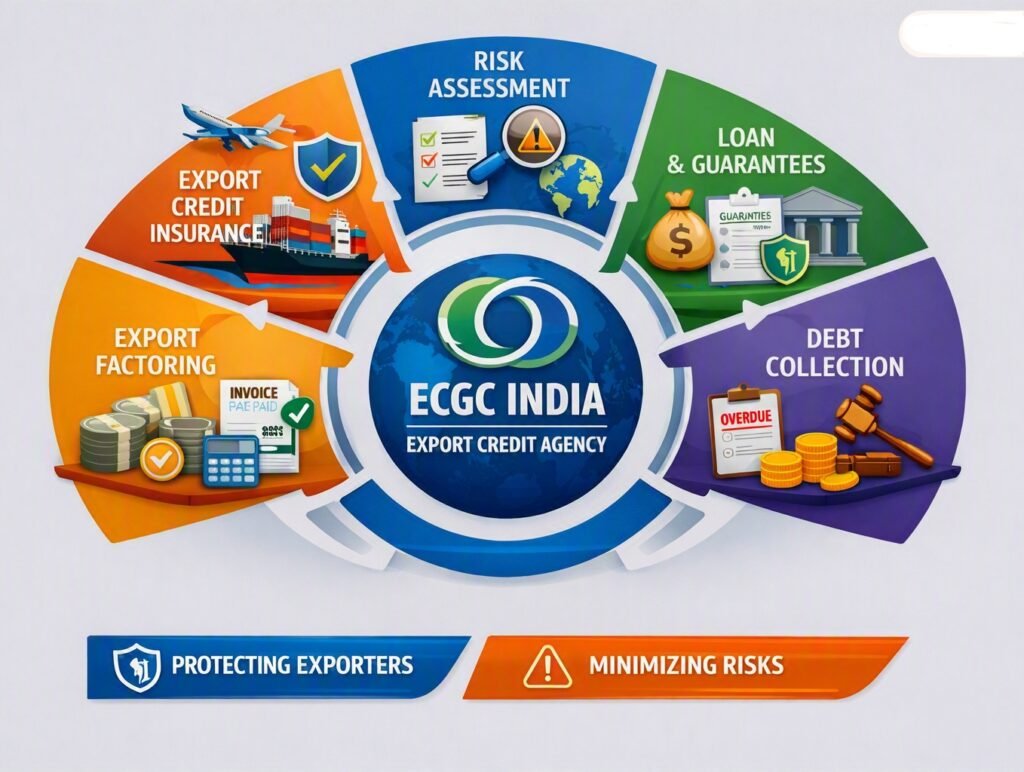
History of ECGC:
The Export Credit Guarantee Corporation of India (ECGC) was established by the Government of India in 1957 to encourage and support Indian exporters by protecting them against certain risks associated with international trade. At that time, Indian exporters faced difficulties because overseas buyers might fail to make payments due to commercial problems or political and economic events in foreign countries. ECGC was created to provide export credit insurance and give greater confidence to exporters and banks.
Initially, ECGC focused mainly on providing insurance protection against risks such as commercial risks and political risks. Its services helped exporters obtain finance from banks because insured export transactions reduced the risk faced by lending institutions. Over the years, ECGC expanded its range of products and services to meet the changing requirements of Indian exporters.
With the growth of India’s international trade, ECGC developed various export credit insurance schemes covering exporters, banks and financial institutions. It also introduced policies for different categories of exporters and transactions. Its activities became particularly important for small and medium exporters that may have limited financial capacity to absorb losses caused by overseas payment defaults.
ECGC has also supported India’s export promotion efforts by providing information about the creditworthiness of foreign buyers and helping exporters manage payment risks. Today, ECGC plays an important role in India’s export finance system by providing insurance protection, supporting banks in extending export credit and encouraging Indian businesses to enter new international markets.
Objectives of ECGC:
1. Promotion of Indian Exports
The primary objective of ECGC is to promote India’s exports by protecting exporters against certain risks associated with international trade. Exporters may face losses when overseas buyers fail to make payments or when political events prevent payment. ECGC provides insurance protection against eligible commercial and political risks. This gives exporters greater confidence to enter foreign markets and undertake larger transactions. By reducing uncertainty, ECGC encourages Indian businesses to explore new countries and expand their export activities. Thus, ECGC contributes to the growth, diversification and competitiveness of India’s exports.
2. Protection Against Commercial Risks
ECGC aims to protect exporters against commercial risks arising from the financial difficulties or actions of foreign buyers. An overseas buyer may become insolvent, fail to pay within the agreed period or refuse to accept goods under certain circumstances. Such events can create significant financial losses for exporters. ECGC provides appropriate insurance cover against eligible risks, subject to the terms of the policy. This protection enables exporters to conduct international business with greater confidence. It is particularly valuable for businesses that may not have sufficient financial resources to absorb large losses from unpaid export transactions.
3. Protection Against Political Risks
International trade can be affected by political and economic events beyond the control of exporters or foreign buyers. Wars, civil disturbances, government restrictions, import bans, currency transfer restrictions and other political events may prevent exporters from receiving payment. ECGC aims to protect exporters against eligible political risks through its insurance policies. Such protection reduces uncertainty associated with selling goods and services to foreign markets. It encourages Indian exporters to consider markets where political risks may otherwise discourage business activity. Political risk protection therefore supports greater geographical diversification of India’s exports.
4. Facilitation of Export Finance
ECGC aims to facilitate the availability of bank finance to exporters. Banks may hesitate to provide export credit because international transactions involve risks related to foreign buyers and overseas markets. ECGC provides insurance and guarantees that can reduce the risks faced by banks and financial institutions. With suitable protection, banks may be more willing to provide pre shipment and post shipment finance to exporters. This improves the availability of working capital and helps exporters fulfil international orders. Thus, ECGC supports the broader export finance system by reducing credit risks associated with international trade.
5. Encouragement of New Exporters
Another objective of ECGC is to encourage businesses, particularly new and smaller exporters, to enter international markets. New exporters may have limited experience in assessing foreign buyers and managing international payment risks. Insurance protection provided through ECGC can reduce some of these concerns and give businesses greater confidence to undertake export transactions. Access to export credit also becomes easier when appropriate insurance protection is available. By supporting new exporters, ECGC contributes to broadening India’s export base and enabling more businesses to participate in international trade.
6. Diversification of Export Markets
ECGC aims to encourage Indian exporters to enter new geographical markets and reduce excessive dependence on a limited number of countries. Exporting to unfamiliar markets may involve greater commercial and political risks because exporters have less information about buyers and local conditions. Insurance protection can reduce some of these risks and encourage businesses to explore new destinations. Market diversification can make India’s export sector more resilient to economic slowdowns, policy changes or demand fluctuations in individual countries. ECGC therefore supports the expansion of Indian exports across different regions and international markets.
7. Support to Small and Medium Exporters
ECGC seeks to support small and medium exporters that may have limited financial resources and risk bearing capacity. A payment default by a foreign buyer can create serious financial difficulties for a smaller business. Export credit insurance provides protection against specified risks and helps such businesses undertake international transactions with greater confidence. ECGC also supports access to bank finance for eligible exporters. By reducing financial uncertainty, its services can help smaller enterprises enter foreign markets, expand their operations and contribute to employment, production and India’s overall export growth.
8. Providing Information on Foreign Buyers
ECGC aims to help exporters manage credit risks by providing relevant information and assessment relating to foreign buyers and markets. Before entering an international transaction, exporters need to understand the financial reliability of buyers and the risks associated with particular countries. Better information enables businesses to make more informed decisions regarding credit terms and export transactions. ECGC’s risk assessment activities support exporters and financial institutions in managing international trade risks. This function is important because effective information about foreign buyers can reduce the possibility of losses arising from unsuitable or unreliable international customers.
9. Strengthening Confidence in International Trade
ECGC aims to increase the confidence of Indian exporters and financial institutions in conducting international business. Export transactions involve uncertainty because payment depends on buyers and economic conditions in foreign countries. Insurance protection reduces the financial impact of specified risks and makes exporters more willing to accept international orders. Banks are also more comfortable extending export credit when suitable risk protection is available. Greater confidence can encourage businesses to expand export volumes, enter new markets and offer competitive credit terms to overseas buyers. ECGC therefore contributes to a stronger and more stable export environment.
10. Supporting National Export Policy
ECGC supports the broader objectives of India’s export promotion and international trade policy. By providing export credit insurance and related guarantees, it helps Indian businesses manage risks that may otherwise discourage international trade. Its activities support exporters across different sectors and markets and help increase their ability to compete globally. ECGC also contributes to the development of export finance by supporting banks and financial institutions. Through these functions, it helps increase export opportunities, strengthen foreign exchange earnings, diversify markets and encourage greater participation of Indian businesses in the global economy.
Working of ECGC:
1. Exporter Applies for Insurance Cover
The working of ECGC begins when an exporter seeks protection against risks associated with an international transaction. The exporter provides relevant information about the business, export products, foreign buyer and proposed transaction. ECGC assesses the exporter, buyer and country related risks before deciding the appropriate insurance cover. Based on its assessment, ECGC issues a suitable export credit insurance policy. The policy specifies the risks covered, percentage of loss protected, conditions and other applicable terms. The exporter pays the required premium and receives protection against eligible losses arising from specified commercial or political risks.
2. Assessment of Foreign Buyer
ECGC assesses the creditworthiness and reliability of foreign buyers before providing appropriate insurance protection. Information regarding the buyer’s financial position, payment record, business reputation and country conditions may be considered. Based on the assessment, ECGC determines the credit limit or level of exposure that can be covered. This process helps exporters avoid excessive risks when offering credit to overseas customers. It also helps ECGC manage its own insurance risk. Proper assessment of foreign buyers is therefore an important part of the working of ECGC and supports safer international trade transactions.
3. Payment of Premium
Exporters obtain insurance protection by paying the applicable premium to ECGC. The premium depends on factors such as the type of policy, destination country, nature of the transaction, period of credit and level of risk. The exporter must comply with the conditions of the policy and pay the required premium within the specified period. In return, ECGC provides protection against eligible commercial and political risks. The premium collected from exporters forms an important part of the financial basis for providing insurance protection. Thus, premium payment is an essential step in the functioning of ECGC’s insurance system.
4. Export Transaction Takes Place
After obtaining suitable insurance protection, the exporter undertakes the international transaction according to the agreed terms. Goods or services are supplied to the foreign buyer, and payment is expected according to the agreed credit period. The exporter must follow the conditions of the ECGC policy while conducting the transaction. The exporter is also expected to take reasonable steps to ensure proper documentation and recovery of outstanding payments. If the buyer pays as agreed, the transaction is completed normally. If a covered risk causes non payment, the exporter may approach ECGC for compensation according to policy conditions.
5. Monitoring of Payment
ECGC expects exporters to monitor payments from foreign buyers and report significant delays or problems according to policy requirements. Exporters must maintain proper records of invoices, shipping documents, payment schedules and communication with buyers. If payment is delayed, the exporter should take appropriate recovery steps and inform ECGC when required. Monitoring helps identify potential losses at an early stage and allows suitable action to be taken. It also helps ECGC assess whether the conditions of the insurance policy have been followed. Proper monitoring is therefore important for effective management of export credit risks.
6. Occurrence of Commercial Risk
A commercial risk may arise when a foreign buyer becomes insolvent, fails to pay or refuses to fulfil certain contractual obligations covered by the policy. When such an event occurs, the exporter may suffer financial loss. The exporter must notify ECGC and provide the required documents and evidence. ECGC examines the circumstances of the default and determines whether the loss falls within the insured risks. If the claim satisfies the policy conditions, ECGC provides compensation for the eligible portion of the loss. This protects exporters from significant financial difficulties caused by buyer related problems.
7. Occurrence of Political Risk
Political risks may arise from events beyond the control of the exporter or foreign buyer. These may include war, civil disturbance, government restrictions, import restrictions or difficulties in transferring payment from the foreign country. If such an event causes a covered loss, the exporter can submit a claim to ECGC. The corporation examines the event, supporting documents and policy conditions before determining the claim. If the loss is covered, ECGC pays compensation according to the applicable terms. Political risk protection enables exporters to undertake transactions in markets where external political conditions create additional uncertainty.
8. Submission and Settlement of Claims
When an insured loss occurs, the exporter submits a claim to ECGC along with relevant documents and information. These may include invoices, shipping documents, payment records, correspondence with the buyer and evidence of the loss. ECGC examines the claim to determine whether the event and loss are covered by the policy. It also checks whether the exporter has complied with policy conditions and taken reasonable steps to recover the amount. After assessment and approval, ECGC settles the eligible claim according to the percentage of cover and other terms specified in the policy.
9. Recovery from Foreign Buyer
After paying a claim, ECGC may take appropriate steps to recover the outstanding amount from the foreign buyer or other responsible parties, subject to the applicable arrangements. Recovery helps reduce the financial loss arising from the insured transaction. The exporter may also be required to cooperate by providing relevant documents and information. The recovery process can involve communication with the buyer, collection agencies, legal procedures or other suitable methods depending on the circumstances. Effective recovery protects the financial position of ECGC and contributes to the sustainability of the export credit insurance system.
10. Support to Banks
ECGC also works with banks and financial institutions by providing suitable guarantees and insurance support for export credit. Banks provide pre shipment and post shipment finance to exporters, but such lending involves risks if exporters or overseas buyers face payment difficulties. ECGC’s guarantees and insurance mechanisms can reduce these risks and encourage banks to provide export finance. This helps exporters obtain working capital required for production, shipment and fulfilment of international orders. Through cooperation with banks, ECGC strengthens India’s export finance system and supports the smooth flow of credit to exporters.
Schemes of ECGC:
1. Standard Policy for Exporters
The Standard Policy is designed to protect exporters against specified commercial and political risks arising from international trade transactions. It generally covers shipments made on short term credit terms. The policy can protect exporters when overseas buyers fail to make payment because of events covered under the policy. It provides greater confidence to exporters while selling goods to foreign customers on credit. The policy also supports exporters in obtaining finance from banks because insured export receivables reduce certain risks. It is particularly useful for exporters regularly undertaking shipments to different international markets.
2. Small Exporters Policy
The Small Exporters Policy is designed to meet the requirements of small exporters with relatively modest export turnover. Small businesses may face greater difficulties in managing losses caused by overseas payment defaults. The policy provides insurance protection against specified commercial and political risks and simplifies the insurance process for eligible exporters. It helps small exporters conduct international transactions with greater confidence and reduces their exposure to payment related risks. The policy also supports access to institutional export finance. By providing suitable protection, ECGC encourages small businesses to enter foreign markets and expand their export activities.
3. Specific Shipment Policy
The Specific Shipment Policy provides insurance protection for individual export transactions or specific shipments where exporters require coverage for particular transactions. It is useful when an exporter does not require a broad policy covering regular exports. ECGC evaluates the buyer, country and transaction before providing appropriate cover. The policy can protect against eligible commercial and political risks associated with the specified shipment. It provides flexibility to exporters undertaking occasional or special export transactions. By reducing the financial uncertainty associated with individual overseas sales, the policy encourages exporters to undertake transactions with foreign buyers while managing payment related risks.
4. Buyer Exposure Policy
The Buyer Exposure Policy provides protection against risks associated with credit extended to a specific foreign buyer. It is useful when an exporter has significant business with an individual overseas customer and wants protection against non payment. ECGC assesses the buyer’s creditworthiness and determines an appropriate level of cover. The policy can protect against specified commercial and political risks according to its terms. Such protection helps exporters confidently offer credit to reliable overseas customers while limiting potential financial losses. It also assists exporters in managing their customer concentration and credit exposure in international markets.
5. Export Turnover Policy
The Export Turnover Policy is intended for exporters who conduct regular export business and require continuing insurance protection. Instead of obtaining separate cover for individual shipments, eligible exporters can obtain protection for their export turnover under a structured policy. The policy covers specified commercial and political risks according to its conditions. It can simplify insurance administration for exporters with frequent international transactions. Continuous coverage helps exporters manage payment risks across multiple shipments and markets. The policy also provides greater confidence when extending credit to overseas buyers and supports the smooth expansion of regular export operations.
6. Consignment Exports Policy
The Consignment Exports Policy provides protection for exporters who send goods to overseas agents or representatives for sale on a consignment basis. Under this arrangement, payment may be received only after the goods are sold in the foreign market. This creates additional risks because the exporter may not immediately receive payment. ECGC provides suitable insurance protection against specified risks according to the policy conditions. The scheme enables exporters to use overseas agents and expand their market presence while managing payment related uncertainty. It is particularly useful for businesses seeking international distribution networks through foreign representatives.
7. Services Policy
ECGC provides insurance support for exporters of services because service transactions also involve payment risks. Indian companies providing services to overseas customers may face delays or non payment due to commercial or political circumstances. Services may include information technology, consultancy, engineering, professional and other eligible services. Appropriate insurance protection helps service exporters manage these risks and conduct business with greater confidence. The policy structure depends on the nature of the service transaction and applicable conditions. By supporting service exporters, ECGC contributes to the expansion of India’s growing services exports and international business activities.
8. Export Finance Guarantee
The Export Finance Guarantee supports banks and financial institutions that provide finance to exporters. Exporters often require pre shipment and post shipment finance to purchase raw materials, manufacture goods and complete international orders. Banks may face risks when exporters experience financial difficulties or when export transactions encounter payment problems. ECGC provides suitable guarantees according to the applicable scheme and conditions, reducing certain risks faced by lending institutions. This encourages banks to provide greater credit to exporters. The scheme therefore strengthens the connection between export credit insurance and institutional finance and supports the growth of India’s export sector.
9. Packing Credit Guarantee
The Packing Credit Guarantee provides support to banks that extend pre shipment finance to exporters. Exporters need packing credit to purchase raw materials, manufacture goods, process orders, package products and prepare shipments before receiving payment from foreign buyers. Banks may face credit risks while providing such finance. ECGC’s guarantee mechanism provides protection against specified risks according to applicable conditions. This encourages banks to extend packing credit and helps exporters obtain working capital in time to fulfil international orders. The scheme therefore supports production for exports and improves the availability of institutional finance to Indian exporters.
10. Export Production Finance Guarantee
The Export Production Finance Guarantee supports financial institutions that provide finance for the production of goods intended for export. Exporters may require substantial funds before receiving payment from overseas customers. The guarantee provides protection to lenders against specified risks and encourages them to finance export production. This enables exporters to purchase inputs, operate production facilities and complete export orders efficiently. By improving access to production finance, the scheme supports export oriented industries and helps businesses fulfil international demand. It also contributes to increased production, employment and foreign exchange earnings through expansion of export activities.

One thought on “Export Credit Guarantee Corporation of India (ECGC), History, Objectives, Working, Schemes”