 by
by Demand analysis is an important part of business economics. It studies consumer demand for goods and services and the factors that influence it. Demand means the quantity of a product that consumers are willing and able to buy at a given price and time. Demand analysis helps firms understand consumer behavior, market trends, and price sensitivity. It includes study of demand function, demand schedule, law of demand, and elasticity of demand. For Indian businesses, demand analysis is useful in forecasting sales, fixing prices, planning production, and avoiding overproduction or shortage. It helps managers take informed decisions in a competitive and changing market environment.
Features/Characteristics of Demand Analysis:
-
Consumer Oriented
Demand analysis is mainly consumer oriented. It focuses on understanding consumer needs, preferences, tastes, and buying behavior. It studies how consumers react to changes in price, income, and fashion. In India, factors like income level, family size, culture, and festivals strongly influence demand. By analyzing consumer behavior, firms can design products that meet customer expectations. This feature helps businesses increase sales and customer satisfaction by producing goods that consumers actually want to buy.
-
Price Sensitive
Demand analysis studies the relationship between price and quantity demanded. According to the law of demand, when price rises, demand falls, and when price falls, demand rises, other factors remaining constant. This feature helps firms understand how much demand will change with price changes. In Indian markets, demand for daily use goods is less price sensitive, while demand for luxury goods is more price sensitive. This analysis helps in fixing suitable prices.
-
Income Related
Income is an important factor in demand analysis. Change in consumer income affects demand for goods and services. When income increases, demand for normal goods increases, while demand for inferior goods may decrease. In India, rising income levels have increased demand for cars, smartphones, and branded products. Demand analysis helps firms understand income demand relationship and plan production accordingly. This feature is useful for market segmentation and targeting different income groups.
-
Effect of Related Goods
Demand analysis considers the effect of related goods on demand. Related goods include substitutes and complementary goods. Increase in price of one good increases demand for its substitute, while increase in price of one good reduces demand for its complement. For example, increase in petrol price reduces demand for cars. In India, tea and coffee, pen and pencil are common substitutes. This feature helps firms understand competitive products and plan marketing strategies.
-
Future Oriented
Demand analysis is future oriented in nature. It helps firms forecast future demand based on past and present data. Demand forecasting helps in production planning, inventory control, and capacity expansion. In India, seasonal demand for products like umbrellas, air conditioners, and woollen clothes is predicted through demand analysis. This feature reduces business risk and avoids losses due to overproduction or shortage.
-
Helpful in Decision Making
Demand analysis supports managerial decision making. It helps in decisions related to pricing, advertising, sales promotion, and market expansion. By understanding demand patterns, firms can choose the right marketing strategy. In Indian business environment, demand analysis helps firms face competition and changing consumer trends. This feature makes demand analysis an essential tool for business planning and growth.
Law of Demand:
The law of demand is one of the most fundamental concepts in economics. It works with the law of supply to explain how market economies allocate resources and determine the prices of goods and services that we observe in everyday transactions. The law of demand states that quantity purchased varies inversely with price. In other words, the higher the price, the lower the quantity demanded. This occurs because of diminishing marginal utility. That is, consumers use the first units of an economic good they purchase to serve their most urgent needs first, and use each additional unit of the good to serve successively lower valued ends.
Economics involves the study of how people use limited means to satisfy unlimited wants. The law of demand focuses on those unlimited wants. Naturally, people prioritize more urgent wants and needs over less urgent ones in their economic behavior, and this carries over into how people choose among the limited means available to them. For any economic good, the first unit of that good that a consumer gets their hands on will tend to be put to use to satisfy the most urgent need the consumer has that that good can satisfy.
For example, consider a castaway on a desert island who obtains a six pack of bottled, fresh water washed up on shore. The first bottle will be used to satisfy the castaway’s most urgently felt need, most likely drinking water to avoid dying of thirst. The second bottle might be used for bathing to stave off disease, an urgent but less immediate need. The third bottle could be used for a less urgent need such as boiling some fish to have a hot meal, and on down to the last bottle, which the castaway uses for a relatively low priority like watering a small potted plant to keep him company on the island.
In our example, because each additional bottle of water is used for a successively less highly valued want or need by our castaway, we can say that the castaway values each additional bottle less than the one before. Similarly, when consumers purchase goods on the market each additional unit of any given good or service that they buy will be put to a less valued use than the one before, so we can say that they value each additional unit less and less. Because they value each additional unit of the good less, they are willing to pay less for it. So the more units of a good consumers buy, the less they are willing to pay in terms of the price.
By adding up all the units of a good that consumers are willing to buy at any given price we can describe a market demand curve, which is always downward-sloping, like the one shown in the chart below. Each point on the curve (A, B, C) reflects the quantity demanded (Q) at a given price (P). At point A, for example, the quantity demanded is low (Q1) and the price is high (P1). At higher prices, consumers demand less of the good, and at lower prices, they demand more.
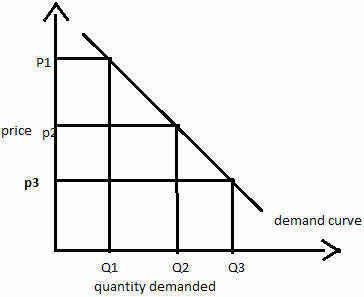
Demand vs Quantity Demanded
In economic thinking, it is important to understand the difference between the phenomenon of demand and the quantity demanded. In the chart, the term “demand” refers to the green line plotted through A, B, and C. It expresses the relationship between the urgency of consumer wants and the number of units of the economic good at hand. A change in demand means a shift of the position or shape of this curve; it reflects a change in the underlying pattern of consumer wants and needs vis-a-vis the means available to satisfy them. On the other hand, the term “quantity demanded” refers to a point along with horizontal axis. Changes in the quantity demanded strictly reflect changes in the price, without implying any change in the pattern of consumer preferences. Changes in quantity demanded just mean movement along the demand curve itself because of a change in price. These two ideas are often conflated, but this is a common error; rising (or falling) in prices do not decrease (or increase) demand, they change the quantity demanded.
Factors Affecting Demand Analysis:
-
Price of the Product
Price is the most important factor affecting demand. According to the law of demand, when the price of a product increases, its demand decreases, and when price decreases, demand increases, other factors remaining constant. In Indian markets, price changes directly affect demand for daily use goods like food items and clothing. Demand analysis studies how sensitive consumers are to price changes. This helps firms decide pricing strategies and discounts to increase sales and market share.
-
Income of Consumers
Income of consumers greatly affects demand. When income increases, demand for normal and luxury goods increases, while demand for inferior goods decreases. In India, rising middle class income has increased demand for smartphones, vehicles, and branded products. Demand analysis helps firms understand income demand relationship and target different income groups. This factor is important for market segmentation and production planning.
-
Prices of Related Goods
Demand is influenced by prices of related goods such as substitutes and complementary goods. If price of a substitute rises, demand for the product increases. If price of a complementary good rises, demand decreases. For example, rise in petrol price reduces demand for cars. In India, tea and coffee are common substitutes. Demand analysis considers this factor to understand competition and interdependence of products in the market.
-
Taste and Preferences
Changes in consumer taste and preferences affect demand. Fashion, lifestyle, advertisement, and social trends influence consumer choices. In India, increasing preference for healthy food has raised demand for organic products. Demand analysis studies these changes to help firms adjust product design and marketing strategies. Ignoring consumer preferences may lead to fall in demand and business loss.
-
Population Size and Structure
Population size and its structure also affect demand. Increase in population increases demand for goods and services. Age composition, gender ratio, and urbanization influence demand pattern. In India, young population has increased demand for education, mobile phones, and online services. Demand analysis helps firms understand demographic trends and plan production accordingly.
-
Expectations of Consumers
Consumer expectations about future prices and income affect present demand. If consumers expect prices to rise, they buy more in present. If they expect fall in income, they reduce current demand. In India, expectation of price rise during festivals increases present demand. Demand analysis considers expectations to forecast demand accurately and help firms prepare better.

2 thoughts on “Demand Analysis, Characteristics, Law of Demand”