 by
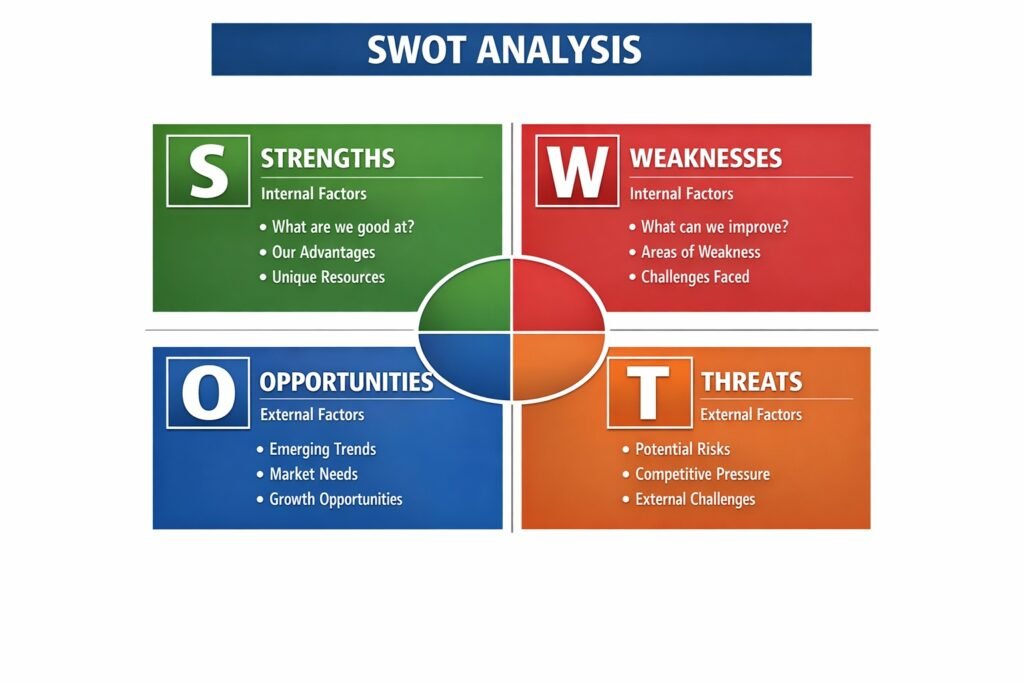
by SWOT Analysis is a strategic tool used to evaluate an organization’s internal and external environment. It focuses on four key elements: Strengths, Weaknesses, Opportunities, and Threats. Strengths and weaknesses represent internal factors, while opportunities and threats relate to external conditions. The purpose of SWOT Analysis is to understand the current position of a business and support effective decision making. It helps in identifying areas of improvement and potential growth. This analysis is simple and widely used in strategic planning. It enables organizations to match their strengths with opportunities and minimize weaknesses and threats.
Importance of SWOT Analysis:
1. Integrates Internal and External Perspectives
SWOT analysis bridges internal and external strategic analysis. Traditional tools examine either inside-out (internal capabilities) or outside-in (environmental conditions). SWOT explicitly combines both: Strengths/Weaknesses (internal) with Opportunities/Threats (external). This integration prevents two strategic errors: pursuing opportunities without necessary internal strengths, or investing in strengths without external market demand. The resulting matrix forces managers to consider alignment simultaneously, grounding strategy in organizational reality and environmental conditions. Without integrated analysis, strategies become either wishful thinking (ignoring weaknesses) or missed opportunities (ignoring favorable external trends).
2. Supports Strategy Formulation
SWOT provides the foundational input for generating strategic alternatives. The TOWS matrix (SWOT reversed) systematically creates four strategy types: SO strategies (use strengths to exploit opportunities), WO strategies (overcome weaknesses to pursue opportunities), ST strategies (use strengths to defend against threats), and WT strategies (minimize weaknesses and avoid threats). This structured approach ensures strategy generation considers all logical combinations, not just comfortable ones. Without SWOT, strategy formulation relies on intuition or imitation, often missing opportunities that require weakness-overcoming or threat-defending strategies. SWOT-based formulation is systematic, auditable, and comprehensive.
3. Clarifies Competitive Advantage
SWOT analysis forces explicit identification of what an organization does better than competitors (strengths) and what competitors do better (weaknesses). This clarification prevents generic claims of “excellence” without comparative grounding. A capability is only a strength if it exceeds competitor capabilities; a deficiency is only a weakness if competitors possess superior alternatives. SWOT requires external benchmarking, not internal self-assessment. True competitive advantage stems from strengths competitors cannot match and weaknesses competitors cannot exploit. Without SWOT discipline, organizations misallocate resources enhancing capabilities that are not genuine strengths or ignoring weaknesses that competitors actively exploit.
4. Simple and Accessible
SWOT’s simplicity is strategic virtue. It requires no specialized training, expensive software, or external consultants. Any manager, entrepreneur, or team can conduct basic SWOT analysis using publicly available information and internal knowledge. This accessibility democratizes strategic thinking across organizational levels, enabling frontline employees to contribute environmental observations and internal capability assessments. Simplicity also facilitates communication: SWOT matrices communicate strategic logic quickly to diverse stakeholders (board members, employees, investors) without jargon. However, simplicity risks superficiality. Effective SWOT requires rigorous analysis beneath each quadrant; the matrix is output, not substitute, for strategic thinking. Accessible does not mean trivial.
5. Identifies Strategic Gaps
SWOT reveals misalignments between internal capabilities and external conditions—strategic gaps requiring attention. A gap exists when important opportunities face internal weaknesses (response required), or significant threats encounter weak defenses (vulnerability). Without SWOT, organizations may remain unaware of these dangerous disconnects, continuing current strategies while conditions become increasingly unfavorable. Gap identification enables priority setting: which weaknesses most urgently require remediation? Which strengths are irrelevant to current opportunities? Gap analysis distinguishes between problems (need fixing) and constraints (must accept). Strategic planning without gap identification often produces incremental improvements, not fundamental repositioning. SWOT highlights where incrementalism fails.
6. Facilitates Strategic Flexibility
SWOT analysis is not a one-time exercise but an ongoing monitoring discipline. Regular SWOT updates (quarterly or annually) track how strengths/weaknesses and opportunities/threats evolve. This continuous scanning enables strategic flexibility: when opportunities shift, organizations redeploy strengths; when threats materialize, they activate defenses; when weaknesses become critical, they invest in remediation. Without regular SWOT updates, strategic plans become increasingly disconnected from changing realities, producing rigidity disguised as commitment. Flexible organizations treat SWOT as living analysis, not static document. Review triggers strategic adjustments before performance deteriorates—proactive rather than reactive. SWOT frequency should match environmental turbulence: stable industries (annual), dynamic industries (quarterly).
7. Supports Resource Allocation
SWOT analysis prioritizes resource allocation by revealing which investments yield highest strategic returns. Strengths aligned with opportunities (SO quadrant) deserve investment—exploit what you do well where market conditions favor you. Weaknesses blocking opportunities (WO) require remediation—invest to overcome. Strengths defending against threats (ST) deserve maintenance—protect what works. Weaknesses exposed to threats (WT) require immediate defensive action or divestment. Without SWOT-based prioritization, resource allocation defaults to politics (powerful divisions) or history (last year’s budget). SWOT introduces rational criteria: resources flow to activities where internal capabilities and external conditions create maximum strategic leverage. Limited resources focus on highest-impact gaps, not comfortable but irrelevant activities.
8. Engages Multiple Perspectives
Effective SWOT analysis involves diverse organizational stakeholders—different functions, levels, geographies, and tenures. Each group perceives different strengths, weaknesses, opportunities, and threats. Sales identifies competitive threats marketing overlooks; frontline operations identifies process weaknesses management ignores; new hires spot outdated practices veterans accept as normal. This multi-perspective input produces richer, more accurate analysis than any single manager or department alone. The process itself builds shared understanding and strategic alignment: stakeholders understand why strategies change when they participated in the analysis driving change. However, multi-perspective SWOT requires facilitation to prevent unproductive conflict (arguing over quadrant placements) and ensure all voices heard, not just loudest.
9. Informs Risk Management
SWOT analysis directly contributes to risk identification and management. Threats quadrant captures external risks: competitor actions, regulatory changes, economic downturns, technological obsolescence. Weaknesses quadrant captures internal vulnerabilities: skill gaps, outdated equipment, poor culture, insufficient capital. Combining weakness-threat (WT) analysis reveals organization’s most dangerous risk exposures—where internal vulnerability meets external hazard. These deserve priority risk mitigation: contingency plans, insurance, capability building, or strategic repositioning. Without SWOT, risk management focuses on generic, industry-standard risks, missing organization-specific vulnerability combinations. SWOT also risks paralysis from over-identification; not all weakness-threat pairs require action. Prioritization distinguishes critical risks from manageable or acceptable risks. SWOT-informed risk management is targeted, not scattershot.
10. Foundation for Strategic Change
When organizations face performance problems or environmental shifts requiring fundamental change, SWOT analysis provides the diagnostic foundation. It answers: Why is current strategy failing? Which weaknesses have become critical? Which threats have materialized? Which opportunities were missed? This diagnosis prevents change efforts that treat symptoms (improve execution of obsolete strategy) rather than causes (restructure strategy-environment alignment). SWOT also guides change content: what capabilities must be built (weaknesses to overcome), what markets to enter/exit (opportunities/threats), what assets to acquire (strengths to add). Without SWOT diagnosis, strategic change becomes change for change’s sake—activity without direction. SWOT ensures change is targeted, justified, and measurable. It also communicates rationale to stakeholders, reducing resistance to necessary but painful strategic repositioning.
Components of SWOT Analysis:
1. Strengths (Internal Positive)
Strengths are internal attributes, resources, and capabilities that enable an organization to outperform competitors and achieve strategic objectives. They answer: “What do we do well?” and “What unique advantages do we possess?” Strengths include tangible assets (proprietary technology, patents, efficient manufacturing, strong balance sheet, prime locations) and intangible assets (brand reputation, skilled workforce, unique organizational culture, customer loyalty, exclusive partnerships, data assets). A capability qualifies as a strength only if it provides competitive advantage relative to rivals—not merely adequate performance. For example, “good customer service” is not a strength if all competitors offer equivalent service. Strengths should be VRIN-tested: Valuable, Rare, Inimitable, Non-substitutable. True strengths are sustainable, not easily copied. Strategic question: Which strengths can we leverage to exploit opportunities? Which strengths defend against threats? Without strength identification, organizations fail to exploit their distinctive capabilities, competing on generic, imitable factors.
2. Weaknesses (Internal Negative)
Weaknesses are internal limitations, deficiencies, or vulnerabilities that hinder organizational performance and place it at competitive disadvantage relative to rivals. They answer: “What do we do poorly?” and “What resources do we lack?” Weaknesses include capability gaps (obsolete technology, skill shortages, inadequate R&D), resource constraints (limited capital, poor locations, small scale), structural problems (bureaucratic decision-making, dysfunctional culture, poor coordination across functions), and reputation issues (brand damage, customer complaints, low employee morale). A deficiency qualifies as a weakness only if competitors possess superior alternatives—not merely room for improvement. Honest weakness identification is psychologically difficult but strategically essential. Unacknowledged weaknesses continue to undermine performance while organizations invest in strengths irrelevant to market requirements. Strategic question: Which weaknesses most critically block opportunity exploitation? Which weaknesses expose us to threats? Weakness remediation priorities flow from gap analysis.
3. Opportunities (External Positive)
Opportunities are external conditions, trends, or changes that the organization could exploit to achieve competitive advantage, expand markets, or improve performance. They answer: “What favorable external developments can we leverage?” and “What unmet needs can we serve?” Opportunities arise from many sources: technological advances (new production methods, digital platforms), market shifts (emerging customer segments, changing preferences, demographic trends), regulatory changes (deregulation, tax incentives, trade agreements), competitor weaknesses (vulnerabilities, exits, failures), and economic conditions (low interest rates, rising disposable income, global expansion). Opportunities exist independent of the organization’s ability to exploit them; an opportunity not matched by internal strengths remains unrealized. Opportunity identification requires active environmental scanning, not passive waiting. Strategic question: Which opportunities align with our strengths? Which require overcoming weaknesses? Not all opportunities are equally valuable—prioritization considers both potential return and probability of successful exploitation.
4. Threats (External Negative)
Threats are external conditions, trends, or changes that could harm the organization’s competitive position, financial performance, or survival. They answer: “What external developments could damage us?” and “What obstacles do we face?” Threats originate from diverse sources: competitive actions (new entrants, rival price cuts, substitute products), technological disruption (obsolescence, new production methods), regulatory changes (new compliance requirements, tax increases, trade restrictions), economic downturns (recession, currency volatility, inflation), social shifts (changing consumer values, demographic decline in target segments), and environmental/supply risks (resource scarcity, climate impacts, supplier concentration). Threats exist regardless of organizational awareness; ignoring threats does not prevent their materialization but does delay response. Strategic question: Which threats most dangerously exploit our weaknesses? Which strengths can defend against threats? Threat identification enables proactive preparation—contingency plans, insurance, capability building, or strategic repositioning—rather than reactive crisis management when threats materialize.
5. Internal vs. External Distinction (The Fundamental Boundary)
SWOT’s core logic rests on the critical distinction between internal factors (Strengths, Weaknesses—controllable, organization-specific) and external factors (Opportunities, Threats—uncontrollable, environment-specific). Misclassification is a common, serious error. Internal factors can be changed through management action: hire/fire, invest/divest, restructure, retrain. External factors must be adapted to because they cannot be directly controlled (though organizations may influence them through lobbying, partnerships, or collective action). Strategic error results when managers treat external factors as changeable (e.g., assuming they can prevent competitor entry) or internal factors as fixed (e.g., accepting skill gaps as unchangeable). The internal-external boundary also guides analysis sequence: first assess external environment (Opportunities, Threats) to understand market conditions, then assess internal capabilities (Strengths, Weaknesses) to determine organizational fit. Understanding this distinction transforms SWOT from checklist to strategic logic.
6. Positive-Negative Duality (Aspirational vs. Defensive)
SWOT organizes strategic thinking along two evaluative dimensions: positive factors (Strengths, Opportunities) that help achieve goals, and negative factors (Weaknesses, Threats) that hinder achievement. Positive factors guide aspirational strategies: leverage strengths to exploit opportunities. Negative factors guide defensive strategies: remediate weaknesses to avoid threats. Both perspectives are essential; overemphasis on positives produces overconfidence and missed vulnerabilities; overemphasis on negatives produces paralysis and missed opportunities. The ratio of positive to negative quadrants varies by industry, economic cycle, and organizational health. Declining industries or distressed organizations may have threats/weaknesses dominating; growth industries or market leaders may have strengths/opportunities dominating. Neither dominance is permanent; continuous monitoring tracks shifts in relative balance. Strategic wisdom lies not in eliminating negatives (impossible) nor ignoring them (dangerous) but in maintaining awareness while acting on positives.
7. Dynamic Nature of SWOT Components
SWOT components are not static; they evolve as internal capabilities and external conditions change. A strength today (proprietary technology) becomes weakness tomorrow if competitors develop superior alternatives. An opportunity today (emerging market) disappears if regulatory changes block entry. A threat today (competitor expansion) may abate if that competitor fails. This dynamism has two strategic implications: First, SWOT analysis must be repeated periodically (quarterly, annually, or with environmental turbulence). Static SWOT from three years ago is worse than useless—it provides false confidence. Second, organizations must monitor rate of change in each component. Fast-changing industries require continuous scanning and frequent SWOT updates; stable industries tolerate longer intervals. Dynamic SWOT also reveals trends: Is our strength deteriorating? Is a threat accelerating? Trend analysis enables proactive action before components shift from positive to negative or vice versa.
8. Prioritization Within Quadrants
Not all strengths are equally valuable; not all weaknesses equally damaging; not all opportunities equally attractive; not all threats equally dangerous. Effective SWOT analysis prioritizes within each quadrant to focus managerial attention on strategic factors, not exhaustive listing. Prioritization criteria: For Opportunities—potential financial return, probability of successful exploitation, alignment with strengths. For Threats—potential damage severity, probability of materialization, imminence. For Strengths—sustainability (difficulty of imitation), relevance to opportunities/threats, distinctiveness from competitors. For Weaknesses—severity of competitive disadvantage, remediability (cost/time to fix), criticality (blocks which opportunities/exposes to which threats). Prioritization transforms SWOT from brainstorming output (long list of factors) to strategic tool (actionable insights). Without prioritization, organizations spread resources thinly across many factors, addressing none effectively. A prioritized SWOT with 3–4 items per quadrant drives more strategic action than comprehensive SWOT with 20 items per quadrant.
9. Competitor-Relative Nature
SWOT factors are inherently comparative, not absolute. A capability is a strength only if superior to relevant competitors; a deficiency is a weakness only if competitors possess superior alternatives. An opportunity exists only if competitors have not already fully exploited it; a threat exists only if competitors could harm the organization. This competitor-relative nature requires external benchmarking, not internal self-assessment. Common SWOT error: listing “experienced workforce” as strength without checking whether competitors have equally or more experienced workforces. Another error: listing “new market” as opportunity without checking whether competitors have already entered and captured positions. Competitor-relative SWOT demands competitive intelligence: competitor capability assessments, market share tracking, patent monitoring, financial ratio comparison. Internal focus alone (what we think we’re good at) produces misleading SWOT. True strategic insight emerges from comparing internal capabilities to external competitors, then matching to market conditions.
10. Actionability Requirement
SWOT components are strategically useful only if they suggest specific actions. “Strength in brand reputation” suggests action: leverage brand to enter related markets, charge premium prices, or defend against price competition. “Weakness in digital capabilities” suggests action: invest in technology, hire digital talent, or partner with digital firms. “Opportunity in aging population” suggests action: develop products for seniors, adjust marketing messages, or acquire complementary services. “Threat from new entrants” suggests action: build entry barriers, lower prices to deter entry, or differentiate to reduce substitutability. SWOT factors that lead to no identifiable action are noise, not insight. Many SWOT exercises produce long lists of unactionable factors: “strong economy” (opportunity—what action? no specific organizational response), “globalization” (threat—what action? too vague). Actionability test: For each factor, ask “What specifically will we do differently because of this factor?” If no answer, eliminate or refine the factor. Actionable SWOT drives strategy; descriptive SWOT merely describes.
Uses of SWOT Analysis in Business:
1. Strategic Planning
SWOT analysis helps in effective strategic planning by providing a clear understanding of internal strengths and weaknesses along with external opportunities and threats. It enables managers to design strategies that match organizational capabilities with market conditions. By using SWOT, businesses can set realistic goals and choose the best course of action. It also helps in prioritizing activities and allocating resources efficiently. This leads to better decision making and improved performance. Overall, SWOT analysis acts as a foundation for developing strong and practical business strategies that support long term growth and success.
2. Identifying Strengths and Weaknesses
SWOT analysis helps businesses identify their internal strengths and weaknesses clearly. Strengths may include skilled employees, strong brand image, or advanced technology, while weaknesses may involve lack of resources or poor management. Understanding these factors helps managers focus on improving weak areas and utilizing strengths effectively. It supports better planning and performance improvement. This awareness also helps in avoiding mistakes and improving efficiency. Overall, SWOT analysis provides a clear picture of internal capabilities and limitations, which is essential for effective decision making and organizational development.
3. Recognizing Opportunities and Threats
SWOT analysis helps businesses identify external opportunities and threats present in the environment. Opportunities may include market growth, new technologies, or changing customer preferences, while threats may involve competition, economic changes, or legal restrictions. By recognizing these factors, organizations can take advantage of favorable conditions and prepare for challenges. This improves adaptability and reduces risks. It also supports proactive decision making. Overall, SWOT analysis enables businesses to respond effectively to external changes and maintain a strong position in the market.
4. Competitive Analysis
SWOT analysis helps in comparing a business with its competitors. It allows organizations to understand their position in the market by evaluating strengths and weaknesses relative to competitors. This helps in identifying areas where the business can improve or differentiate itself. It also supports better marketing and pricing strategies. By analyzing competitors, firms can develop effective plans to gain competitive advantage. Overall, SWOT analysis improves understanding of the competitive environment and helps businesses perform better in the market.
5. Decision Making
SWOT analysis supports better decision making by providing a structured approach to evaluating different factors affecting the business. It helps managers analyze alternatives and choose the most suitable option. By considering both internal and external factors, decisions become more balanced and logical. It reduces uncertainty and risk. This leads to improved efficiency and effectiveness in operations. Overall, SWOT analysis enhances the quality of decisions and ensures that actions are aligned with organizational goals and market conditions.

One thought on “SWOT Analysis, Importance, Components, Uses”