 by
by Service Life Cycle refers to the different stages through which a service passes from its introduction to its decline in the market. It explains how a service is developed, introduced, grows, matures, and finally declines over time. Similar to a product life cycle, it helps businesses understand the performance and demand of a service at each stage. The main stages include introduction, growth, maturity, and decline. Each stage requires different marketing strategies and management decisions. In simple terms, Service Life Cycle is the process that shows the life span of a service in the market.
Functions of Service Life Cycle:
1. Helps in Planning and Strategy
Service life cycle helps organizations in effective planning and strategy making. By understanding different stages of a service, businesses can decide suitable actions for each stage. For example, during introduction, focus is on promotion, while in maturity, focus is on competition and improvement. It helps managers allocate resources properly and set clear goals. Planning based on life cycle stages reduces uncertainty and improves decision making. Organizations can also prepare for future changes in demand. Overall, it provides a structured approach to manage services efficiently and achieve long term success in the market.
2. Assists in Market Analysis
Service life cycle helps in analyzing market conditions at different stages. It allows businesses to understand customer demand, competition, and market trends. During growth, demand increases, while in maturity, competition becomes strong. By studying these changes, organizations can adjust their strategies accordingly. It also helps in identifying new opportunities and threats in the market. Market analysis becomes easier when businesses know the stage of the service. This improves decision making and reduces risks. Overall, service life cycle supports better understanding of the market environment and helps organizations stay competitive and responsive to changes.
3. Improves Resource Allocation
Service life cycle helps in proper allocation of resources such as money, time, and manpower. Different stages require different levels of investment. For example, introduction stage needs high promotion cost, while maturity stage focuses on maintaining quality. By understanding these needs, organizations can use their resources effectively. It prevents wastage and ensures that resources are used where they are most needed. Proper allocation also improves efficiency and productivity. Businesses can plan budgets and workforce requirements based on the life cycle stage. This leads to better performance and helps organizations achieve their objectives in a systematic manner.
4. Supports Pricing Decisions
Service life cycle plays an important role in pricing decisions. At the introduction stage, prices may be set high or low depending on the strategy. During growth, prices may be adjusted based on demand and competition. In maturity, competitive pricing becomes important to maintain market share. In decline, prices may be reduced to attract customers. By understanding these stages, organizations can set appropriate pricing strategies. It helps in maximizing profit and maintaining competitiveness. Pricing decisions become more effective when they are aligned with the service life cycle, ensuring better financial performance and customer acceptance.
5. Helps in Marketing and Promotion
Service life cycle guides marketing and promotional activities. Different stages require different promotional strategies. In the introduction stage, awareness is created through advertising and promotions. During growth, focus is on building brand preference. In maturity, promotional efforts aim to differentiate the service from competitors. In decline, promotions may be reduced or targeted. Understanding the life cycle helps marketers design suitable campaigns. It ensures that promotional efforts are effective and aligned with market conditions. This improves customer reach and engagement. Overall, service life cycle helps organizations manage marketing activities in a planned and efficient manner.
6. Assists in Service Improvement
Service life cycle helps organizations identify the need for service improvement. During maturity stage, customer expectations increase and competition becomes intense. Businesses must improve their services to maintain customer interest. By analyzing feedback and performance, organizations can make necessary changes. Improvements may include adding new features, enhancing quality, or improving customer service. It also helps in innovation and development of new services. Continuous improvement ensures that the service remains relevant in the market. Service life cycle provides guidance on when and how improvements should be made for better performance and customer satisfaction.
7. Helps in Managing Competition
Service life cycle helps organizations manage competition effectively. In the growth and maturity stages, competition becomes strong as more players enter the market. Businesses need to develop strategies to compete and maintain their position. This may include improving service quality, reducing costs, or offering unique features. By understanding the stage of the life cycle, organizations can anticipate competitive pressures. It also helps in identifying strengths and weaknesses compared to competitors. Effective competition management ensures survival and growth in the market. Service life cycle provides a clear framework to handle competition at different stages.
8. Supports Decision Making
Service life cycle supports managerial decision making by providing clear insights into service performance. It helps managers decide whether to expand, modify, or discontinue a service. At different stages, different decisions are required to maintain profitability and growth. For example, investment decisions are important in early stages, while cost control is needed in maturity. It also helps in forecasting future trends and planning accordingly. By using service life cycle information, managers can make informed and timely decisions. This reduces risks and improves efficiency, helping organizations achieve better results in a competitive market.
Stages of Service Life Cycle:
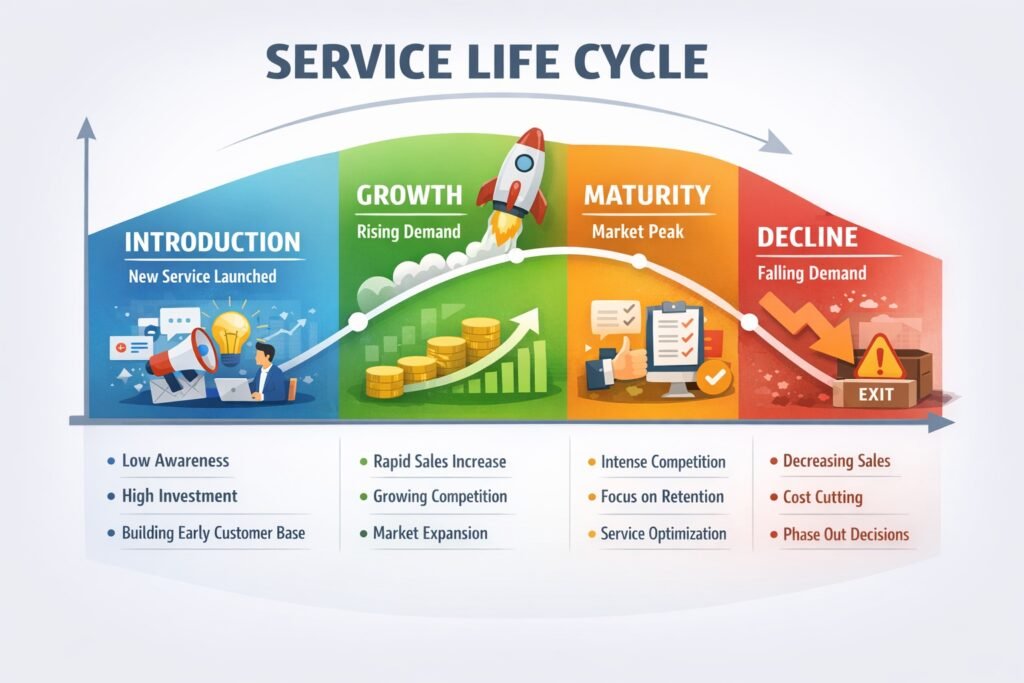
1. Introduction Stage
The introduction stage is the first stage of the service life cycle where a new service is launched in the market. At this stage, customer awareness is low, and demand is limited. Organizations focus on creating awareness through advertising, promotion, and education. High investment is required for marketing and service development. Competition is usually low because the service is new. Pricing strategies may be high or low depending on business goals. Service providers also focus on building trust and attracting early customers. Feedback from customers is important to improve the service. The main objective in this stage is to introduce the service successfully and create a strong base for future growth.
2. Growth Stage
The growth stage is characterized by increasing demand and rising popularity of the service. More customers become aware of the service and start using it. Sales and revenue increase rapidly during this stage. Competition also starts increasing as new firms enter the market. Organizations focus on improving service quality and expanding their reach. Marketing efforts are directed towards building brand preference and customer loyalty. Prices may stabilize or slightly decrease due to competition. Service providers may also introduce variations or additional features to attract more customers. The main goal of this stage is to strengthen market position and maximize growth opportunities.
3. Maturity Stage
The maturity stage is the stage where the service reaches its peak in terms of demand and market share. Growth slows down as most potential customers are already using the service. Competition becomes very intense, and many firms offer similar services. Organizations focus on maintaining their market share and improving efficiency. Strategies such as service differentiation, promotional offers, and customer retention become important. Prices may be reduced to stay competitive. Service providers also focus on improving quality and customer experience. Innovation may be introduced to extend the life of the service. The main objective in this stage is to sustain performance and remain competitive in the market.
4. Decline Stage
The decline stage is the final stage of the service life cycle where demand starts decreasing. This may happen due to changes in customer preferences, technological advancements, or increased competition. Sales and profits begin to fall during this stage. Organizations may reduce investment and promotional activities. Some firms may withdraw the service from the market, while others may try to revive it by making improvements or targeting new segments. Cost control becomes important to maintain profitability. The focus is on minimizing losses and making strategic decisions about the future of the service. This stage indicates the end of the service’s life cycle in the market.
Limitations of Service Life Cycle:

One thought on “Service Life Cycle, Functions, Stages, Limitations”