 by
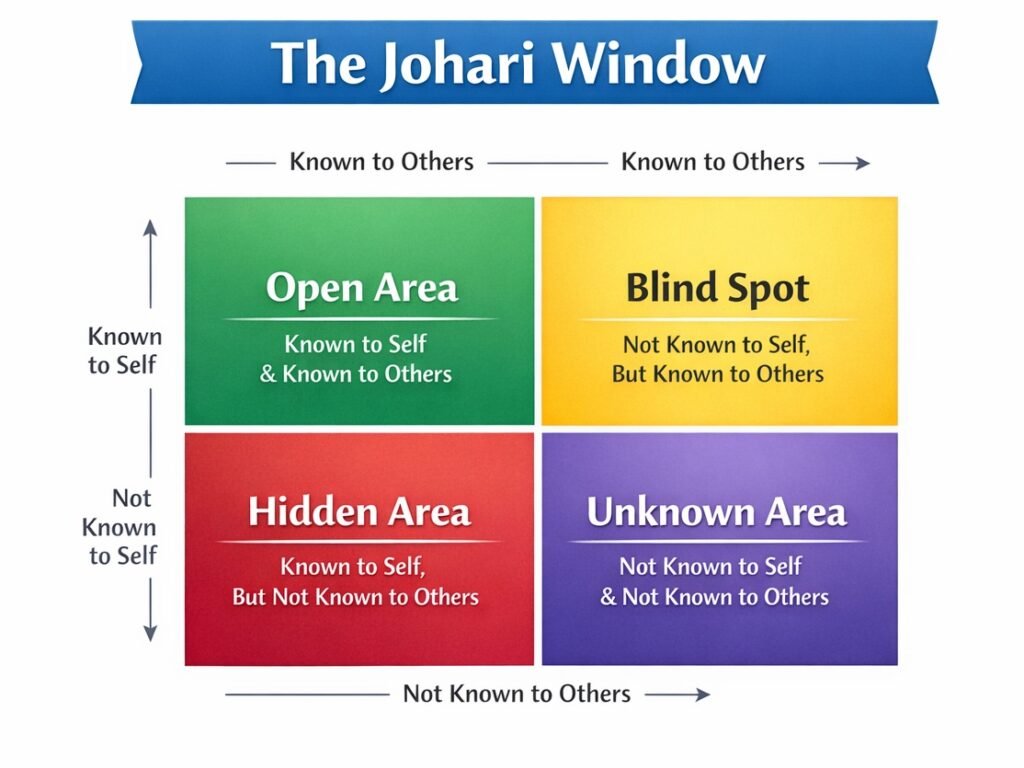
by The Johari Window, developed by American psychologists Joseph Luft and Harrington Ingham in 1955, is a simple yet powerful model for understanding self-awareness, interpersonal communication, and mutual understanding. The name “Johari” combines the first syllables of its creators’ first names. The model represents the self as four quadrants or “panes” based on what is known to self and known to others: open area, blind area, hidden area, and unknown area. The Johari Window facilitates personal development by encouraging individuals to expand their open area through feedback solicitation and self-disclosure. In organisations, it enhances team communication, reduces misunderstandings, builds trust, and improves interpersonal effectiveness by helping members understand how they are perceived by others.
Four Quadrants of the Johari Window:
1. Open Area (Public Self)
The open area, also called the public self or arena, represents information known to both the individual and others. This quadrant includes behaviours, feelings, motivations, knowledge, skills, and attitudes that are openly shared and mutually recognised. Examples include publicly stated values, demonstrated competencies, expressed opinions, and visible personality traits. The size of the open area expands through effective communication, self-disclosure, and feedback. In organisational settings, individuals with large open areas are perceived as transparent, trustworthy, and approachable. Team effectiveness improves when members operate with expanded open areas, reducing misunderstandings and hidden agendas. The goal of personal and interpersonal development through the Johari Window is to enlarge this quadrant by reducing the blind, hidden, and unknown areas.
2. Blind Area (Blind Self)
The blind area represents information unknown to the individual but known to others. This quadrant includes blind spots—behaviours, habits, or impacts that others observe but the individual fails to recognise. Examples include unconscious mannerisms, unintended communication styles, unacknowledged strengths or weaknesses, and the effect of one’s behaviour on others. The blind area can be a source of interpersonal friction, as individuals may be unaware of how they are perceived. Reducing the blind area requires soliciting and accepting feedback from others with openness and non-defensiveness. In organisations, individuals with large blind areas may experience repeated conflicts or stalled careers without understanding why. Active feedback-seeking behaviour progressively shrinks this quadrant, enhancing self-awareness.
3. Hidden Area (Hidden Self)
The hidden area contains information known to the individual but concealed from others. This quadrant includes private feelings, personal history, fears, ambitions, secrets, and opinions intentionally kept undisclosed. Individuals maintain hidden areas for various reasons—fear of judgment, vulnerability concerns, professional boundaries, or strategic considerations. While some privacy is healthy and necessary, excessively large hidden areas hinder authentic relationships and effective collaboration. In organisational contexts, withholding relevant information about concerns, limitations, or disagreements can impede problem-solving and trust-building. Reducing the hidden area involves appropriate self-disclosure—sharing relevant thoughts and feelings with others based on trust levels and situational appropriateness. Strategic disclosure strengthens relationships without compromising necessary boundaries.
4. Unknown Area (Unknown Self)
The unknown area represents information unknown to both the individual and others. This quadrant includes latent talents, unrecognised potential, subconscious motivations, repressed memories, undiscovered capabilities, and yet-to-emerge responses to novel situations. The unknown area may also contain fears, biases, or behavioural patterns not yet manifested or recognised. Accessing this quadrant requires various discovery methods—self-reflection, psychotherapy, personality assessments, challenging experiences, creative exploration, and feedback that reveals unexpected patterns. In organisations, unlocking the unknown area enables employees to discover untapped strengths, new interests, and expanded capabilities. Leadership development programs often aim to reduce the unknown area through experiential learning, 360-degree feedback, and stretch assignments that reveal capacities individuals and others did not know existed.
Johari Window Application in Organisations:
1. Enhancing Team Communication
The Johari Window improves team communication by helping members understand how they are perceived and what information remains hidden. Teams that openly discuss the model create shared language for addressing communication gaps. Members learn to expand their open areas through appropriate self-disclosure and constructive feedback. When team members reduce blind spots (through feedback) and hidden areas (through disclosure), misunderstandings decrease and collaboration improves. The model encourages transparency without forcing uncomfortable exposure. Teams using Johari principles develop norms of openness where members feel safe sharing relevant information and receiving behavioural feedback. Enhanced communication reduces conflict arising from assumptions, hidden agendas, or unrecognised behaviours, enabling more efficient and harmonious team functioning.
2. Leadership Development
Leadership development programs use the Johari Window to increase self-awareness—a foundational leadership competency. Leaders receive 360-degree feedback revealing blind spots—behaviours others observe but leaders miss. This feedback reduces the blind quadrant, enabling leaders to understand their impact on others. Simultaneously, leaders learn appropriate self-disclosure to reduce hidden areas, building authenticity and trust with teams. As leaders expand their open areas, they model transparency, encouraging similar behaviour throughout organisations. The Johari Window helps leaders understand that effective leadership requires balancing disclosure (sharing rationale, admitting limitations) with feedback solicitation (actively seeking input). Self-aware leaders make better decisions, build stronger relationships, and create psychological safety enabling team members to contribute fully.
3. Performance Feedback Processes
Performance management systems apply the Johari Window to make feedback more effective and less threatening. The model explains why employees may react defensively to feedback—it reveals previously unknown information, reducing the blind area. Understanding this dynamic helps managers deliver feedback compassionately, recognising that receiving new self-knowledge can be uncomfortable. The Johari Window also encourages employees to solicit feedback proactively, shrinking blind areas before formal reviews. For feedback to expand the open area, organisations must create psychological safety where receiving constructive input is viewed as developmental rather than punitive. Managers trained in Johari principles frame feedback as mutual exploration—both parties learning together—rather than one-way criticism, increasing acceptance and behavioural change.
4. Conflict Resolution
The Johari Window provides framework for resolving interpersonal conflict by identifying information gaps causing misunderstandings. Many conflicts arise from blind areas (one party unaware of their behaviour’s impact) or hidden areas (relevant information not shared). Conflict resolution processes guided by Johari principles encourage parties to disclose hidden concerns and provide feedback revealing blind spots. As both parties expand their open areas, they develop shared understanding of issues, reducing assumptions and misinterpretations. The model emphasises that conflict often persists because each party operates with incomplete information about the other’s perspective. By systematically reducing unknown and hidden information through structured dialogue, mediators help disputants find common ground. The Johari Window transforms conflict from blame-focused to discovery-focused.
5. Building Trust in Teams
Trust development directly correlates with Johari Window dynamics—trust grows as open areas expand through mutual disclosure and feedback. When team members appropriately share relevant information (reducing hidden areas) and openly receive feedback (reducing blind areas), they demonstrate vulnerability and commitment to mutual understanding. This reciprocal process builds predictability, reliability, and psychological safety. The Johari Window illustrates that trust cannot be mandated; it emerges from iterative cycles of disclosure and feedback that progressively enlarge shared knowledge. Teams using the model explicitly discuss what information should be shared to improve collaboration, establishing norms for appropriate transparency. As trust increases, team members risk greater disclosure, creating virtuous cycles where open areas expand further, deepening trust and enabling higher performance.
6. Onboarding and New Employee Integration
Organisations apply the Johari Window to accelerate new employee integration and reduce early-career misunderstandings. New hires enter with large hidden areas (organisation knows little about them) and large blind areas (they don’t understand organisational norms or how others perceive them). Structured onboarding using Johari principles includes feedback sessions where new employees learn how their behaviour aligns with expectations (reducing blind areas) and opportunities to share relevant backgrounds and preferences (reducing hidden areas). Mentors and managers help new employees understand unwritten rules and cultural norms, systematically expanding the open area. This accelerated open-area expansion reduces early confusion, builds relationships faster, and helps new employees contribute effectively sooner, improving retention and satisfaction.
7. Diversity and Inclusion Initiatives
Diversity and inclusion efforts benefit from Johari Window applications addressing cross-cultural misunderstandings. Individuals from different backgrounds operate with differing hidden assumptions, blind spots about how their communication styles affect others, and unknown areas about alternative perspectives. The Johari Window provides non-threatening framework for exploring these differences—participants disclose relevant cultural norms (reducing hidden areas) and receive feedback about unintended impacts (reducing blind areas). Inclusion training using the model encourages participants to expand open areas across identity groups without requiring uncomfortable exposure. The model normalises that everyone has blind spots and hidden areas, reducing defensiveness around diversity conversations. By systematically expanding mutual understanding, organisations build more inclusive cultures where differences become assets rather than sources of friction.
8. Coaching and Mentoring Relationships
Coaching and mentoring relationships use the Johari Window to guide developmental conversations. Coaches help clients identify blind spots—behaviours or patterns visible to others but unrecognised by clients—through structured feedback and observation. They also encourage appropriate disclosure of hidden concerns, fears, and aspirations that, when shared, enable targeted development planning. The model provides framework for exploring unknown areas—untapped strengths or unrecognised potential—through assessment tools and stretch experiences. Effective coaches help clients understand which quadrant expansion matters most for specific goals: reducing blind spots for leadership effectiveness, reducing hidden areas for authentic relationships, or exploring unknown areas for career direction. The Johari Window makes coaching conversations systematic, giving clients vocabulary for self-awareness development.
