 by
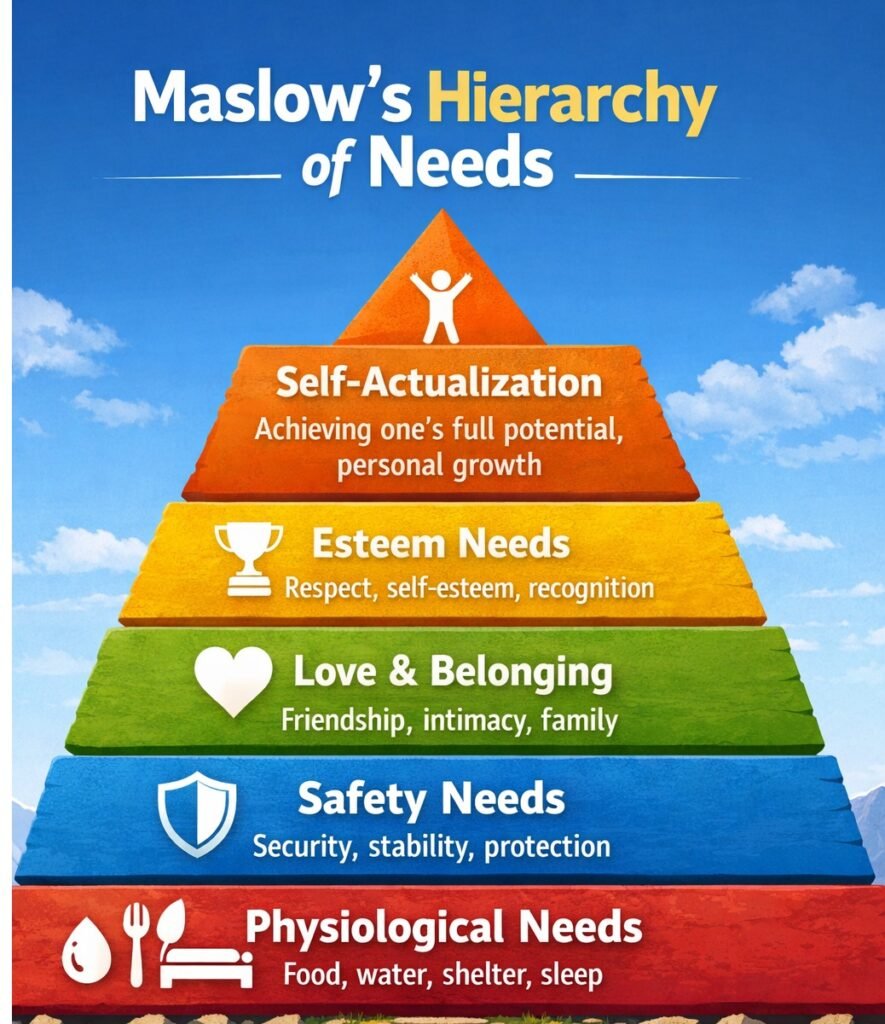
by Abraham Maslow’s Hierarchy of Needs is a foundational theory in understanding human motivation. Proposed in 1943, it suggests that individuals are motivated to fulfill a hierarchy of five innate needs, progressing from basic physiological requirements to higher-order psychological needs. Maslow posited that lower-level needs must be substantially satisfied before higher-level needs become motivating forces. This theory revolutionized organisational behaviour by shifting focus from purely economic incentives to understanding employees as whole persons with evolving needs. While subsequent research has refined Maslow’s propositions, his framework remains influential for understanding motivation, job design, and employee engagement in contemporary organisations.
Levels of Maslow’s Hierarchy of Needs:
1. Physiological Needs
Physiological needs represent the most fundamental level of Maslow’s hierarchy—the biological requirements for human survival. These include air, water, food, shelter, sleep, and clothing. In organisational contexts, this translates to adequate compensation enabling employees to afford basic necessities, safe working conditions, and reasonable work hours allowing sufficient rest. Maslow proposed that until these foundational needs are reasonably satisfied, they dominate motivation; individuals focus primarily on securing survival requirements rather than pursuing higher aspirations. Organisations addressing physiological needs provide competitive wages, comfortable workspaces, rest breaks, and health benefits. When employees struggle with basic survival concerns—financial insecurity, unsafe conditions, or excessive fatigue—they cannot focus on engagement, creativity, or organisational commitment. Addressing physiological needs establishes the essential foundation upon which all motivation is built.
2. Safety Needs
Once physiological needs are met, safety needs emerge as primary motivators—the desire for security, stability, and protection from physical and emotional harm. In workplaces, safety needs manifest as job security, safe working environments, financial stability, health insurance, and protection from harassment or discrimination. Employees seek predictable employment, clear policies, fair treatment, and freedom from arbitrary decisions. Organisations address safety needs through employment contracts, transparent performance management, safety protocols, grievance procedures, and retirement benefits. When safety needs are unmet—during layoff threats, unstable conditions, or unsafe practices—employees experience anxiety, disengagement, and defensive behaviours. Meeting safety needs creates psychological stability, enabling employees to invest attention beyond self-protection. A secure environment provides the foundation for pursuing belonging, esteem, and self-actualisation.
3. Social Needs
Social needs—also called belongingness or love needs—emerge when physiological and safety requirements are reasonably satisfied. These needs encompass desires for meaningful relationships, acceptance, friendship, and a sense of belonging within groups. In organisations, social needs manifest as workplace friendships, team cohesion, supportive supervision, and inclusive cultures where employees feel valued as members. Employees seek connection through collaborative work, social interactions, mentoring relationships, and participation in group activities. Organisations address social needs through team-based structures, communication channels, recognition programs, and fostering psychological safety. When social needs remain unmet, employees experience isolation, loneliness, and disengagement regardless of compensation or job security. Satisfying social needs transforms workplaces from transactional environments into communities where individuals experience belonging and invest emotionally in collective success.
4. Esteem Needs
Esteem needs encompass desires for recognition, respect, achievement, status, and a sense of competence. These needs divide into two categories: respect from others (recognition, appreciation, status) and self-respect (confidence, mastery, independence). In organisations, employees seek meaningful feedback, recognition for contributions, challenging assignments that demonstrate competence, and opportunities for advancement. Job titles, awards, performance acknowledgment, and leadership roles address esteem needs. Organisations meeting esteem needs provide regular constructive feedback, celebrate achievements, delegate meaningful responsibility, and create clear career progression pathways. When esteem needs are frustrated—through neglect, criticism without recognition, or stagnant roles—employees experience diminished self-worth, reduced motivation, and may disengage or seek validation elsewhere. Fulfilling esteem needs builds confident, motivated employees who contribute fully and take pride in their work.
5. Self-Actualisation
Self-actualisation represents the highest level of Maslow’s hierarchy—the desire to become everything one is capable of becoming. This involves realising personal potential, pursuing growth, creativity, and meaningful achievement. Unlike lower needs, self-actualisation is never fully satisfied; individuals continue seeking growth opportunities throughout their lives. In organisations, self-actualisation manifests as challenging assignments that stretch capabilities, autonomy in decision-making, creative problem-solving, opportunities for innovation, and roles aligned with personal values and passions. Organisations supporting self-actualisation provide professional development, encourage initiative, offer challenging projects, and create cultures where meaningful work matters beyond financial rewards. When employees pursue self-actualisation at work, they demonstrate intrinsic motivation, engagement, and commitment that transcends external incentives, contributing fully to organisational success while realising their own potential.
6. Cognitive Needs (Extended)
Although not part of Maslow’s original five-level model, he later acknowledged cognitive needs as additional motivators—the desire for knowledge, understanding, curiosity, and exploration. These needs involve seeking meaning, learning new skills, and making sense of one’s environment. In organisations, cognitive needs manifest as desires for training, exposure to new ideas, challenging intellectual work, and opportunities to master complex concepts. Employees motivated by cognitive needs seek roles offering continuous learning, problem-solving challenges, and intellectual stimulation. Organisations address cognitive needs through professional development programs, cross-functional projects, access to information, and cultures that value curiosity. When cognitive needs remain unmet, employees experience boredom, stagnation, and disengagement. Satisfying cognitive needs enables innovation, adaptability, and sustained intellectual engagement essential for knowledge-based organisational success.
7. Aesthetic Needs (Extended)
Maslow also recognised aesthetic needs as motivators—the desire for beauty, balance, order, and pleasing experiences. These needs involve appreciation of art, nature, harmony, and well-designed environments. In organisations, aesthetic needs manifest as preferences for visually appealing workspaces, well-designed processes, harmonious workflows, and organisational elegance. Employees respond positively to environments that are orderly, aesthetically pleasing, and free from chaos. Organisations address aesthetic needs through thoughtful workplace design, attention to visual presentation, systematic processes reducing friction, and cultivating harmony in interpersonal dynamics. When aesthetic needs are ignored—through chaotic environments, visual clutter, or disorderly systems—employees experience subtle but persistent dissatisfaction. Attending to aesthetic needs contributes to workplace satisfaction, reduces cognitive friction, and creates environments where employees experience psychological ease alongside productivity.
8. Transcendence Needs (Extended)
In his later work, Maslow added transcendence as the highest level beyond self-actualisation—the desire to help others achieve their potential and connect with something beyond the self. Transcendence involves altruism, service, and contributing to causes larger than personal advancement. In organisations, transcendence manifests as mentoring others, sharing knowledge, contributing to community, and aligning work with meaningful social impact. Employees motivated by transcendence seek purpose beyond individual achievement—they derive satisfaction from developing colleagues, improving their communities, and making lasting contributions. Organisations supporting transcendence provide mentoring opportunities, encourage knowledge sharing, engage in corporate social responsibility, and articulate meaningful missions. When transcendence needs are recognised, employees experience deeper fulfilment, viewing their work as contribution to broader good rather than merely personal advancement or financial reward.
Maslow and Its Application in Organisation:
1. Application: Physiological Needs
Organisations address employees’ physiological needs through foundational compensation and working conditions. Competitive salaries ensure employees can afford food, housing, and basic necessities without financial stress. Adequate rest breaks, reasonable working hours, and comfortable physical environments—proper ventilation, lighting, temperature control—support basic biological functioning. Cafeterias, hydration stations, and ergonomic workstations further address these needs. When organisations neglect physiological foundations, employees focus on survival rather than organisational goals. A person worried about paying rent cannot fully engage in strategic thinking or creative problem-solving. Progressive organisations recognise that addressing physiological needs is not merely compliance but strategic investment—creating conditions where employees bring full attention and energy to their work rather than being distracted by basic survival concerns.
2. Application: Safety Needs
Organisations address safety needs through job security, stable employment practices, and safe working conditions. Employment contracts, transparent performance management, and layoff policies that communicate clearly reduce uncertainty. Physical safety measures—emergency protocols, security systems, ergonomic equipment—protect employees from harm. Psychological safety encompasses protection from harassment, discrimination, and arbitrary treatment through robust policies and grievance mechanisms. Retirement benefits, health insurance, and disability coverage provide long-term security. When employees trust that their jobs are stable and their well-being protected, they focus energy on productivity rather than defensive behaviors. Organisations that fail safety needs experience anxiety, reduced risk-taking, and disengagement. A secure environment enables employees to invest beyond self-protection toward higher-order contributions.
3. Application: Social Needs
Organisations address social needs by fostering workplace relationships, team cohesion, and inclusive cultures. Team-based structures, collaborative projects, and open workspaces create interaction opportunities. Mentoring programs, employee resource groups, and social events help employees form meaningful connections. Supervisors trained in relationship-building create environments where employees feel valued as individuals, not merely workers. Recognition of personal milestones—birthdays, work anniversaries—demonstrates genuine care. When social needs are met, employees develop emotional attachment to colleagues and organisations, enhancing collaboration, knowledge sharing, and mutual support. Organisations neglecting social needs experience isolation, silos, and reduced commitment. Creating belonging transforms workplaces from transactional settings into communities where employees invest discretionary effort and remain loyal through challenges.
4. Application: Esteem Needs
Organisations address esteem needs through recognition systems, meaningful responsibility, and career advancement opportunities. Performance feedback should be regular, specific, and affirming—acknowledging contributions publicly while providing constructive guidance. Job titles, awards, and formal recognition programs signal appreciation. Delegating challenging assignments demonstrates trust in employee capabilities. Clear career paths, promotion criteria, and development opportunities enable employees to see growth trajectories. Leadership roles, cross-functional project leads, and decision-making authority provide status and self-respect. When esteem needs are fulfilled, employees develop confidence, take pride in work, and willingly assume greater responsibility. Organisations neglecting esteem experience disengagement, as employees feel undervalued regardless of compensation. Fulfilling esteem needs transforms capable employees into committed contributors who invest fully in organisational success.
5. Application: Self-Actualisation
Organisations address self-actualisation through opportunities for meaningful work, creativity, and personal growth. Challenging assignments that stretch capabilities allow employees to realise potential. Autonomy in decision-making enables ownership and creative expression. Professional development programs, tuition reimbursement, and skill-building workshops support continuous growth. Job rotation, cross-functional projects, and innovation initiatives provide variety and learning. Alignment between individual values and organisational mission enables employees to find purpose beyond tasks. When organisations create conditions for self-actualisation, employees experience intrinsic motivation—working passionately because work itself fulfills them. Neglecting this need leads to stagnation and disengagement among high-potential talent. Self-actualisation transforms work from means to end, enabling employees to contribute fully while achieving personal fulfilment.
6. Application: Cognitive Needs
Organisations address cognitive needs through continuous learning opportunities and intellectually stimulating work. Training programs, workshops, and access to online learning platforms satisfy desires for knowledge acquisition. Challenging problems that require analysis, creativity, and complex thinking engage curious minds. Cross-functional exposure, industry conferences, and knowledge-sharing forums provide intellectual variety. Encouraging questions, experimentation, and exploration signals that curiosity is valued. Innovation labs, research time, and stretch assignments enable employees to pursue interests beyond routine responsibilities. When cognitive needs are met, employees remain engaged, adaptable, and capable of solving novel problems. Organisations neglecting cognitive needs experience stagnation, as employees disengage from routine without intellectual challenge. Satisfying cognitive needs builds learning organisations capable of continuous adaptation in dynamic environments.
7. Application: Aesthetic Needs
Organisations address aesthetic needs through thoughtful workplace design, visual harmony, and orderly processes. Well-designed offices with natural light, plants, art, and pleasing aesthetics create environments where employees experience comfort and inspiration. Clean, organised workspaces reduce cognitive load and stress. Attention to visual presentation—branding, materials, digital interfaces—signals quality and care. Harmonious workflows with minimal friction, logical processes, and elegant systems satisfy preferences for order and balance. Even in functional environments, creating spaces that are pleasant and processes that feel coherent addresses subtle but meaningful needs. When aesthetic needs are acknowledged, employees experience satisfaction beyond productivity—they take pride in environments where they spend substantial time. Organisations neglecting aesthetics may operate efficiently but miss opportunities for enhanced well-being and workplace satisfaction.
8. Application: Transcendence Needs
Organisations address transcendence needs through mentoring programs, knowledge sharing, and meaningful social impact. Opportunities to develop others—coaching junior colleagues, mentoring, teaching—enable employees to contribute beyond self. Knowledge management systems, communities of practice, and collaborative cultures support legacy-building. Corporate social responsibility initiatives, sustainability efforts, and community engagement allow employees to connect work with broader purpose. Articulating organisational mission that emphasises positive impact beyond profit enables employees to see their contributions as meaningful beyond individual advancement. When transcendence needs are addressed, employees experience deeper fulfilment, viewing their work as contribution to something larger. Organisations that support transcendence benefit from engaged employees who remain committed through challenges, finding meaning that transcends transactional employment relationships.
Criticisms of Maslow’s Hierarchy of Needs:
