 by
by The Value Chain, developed by Michael Porter, is a strategic framework that disaggregates an organization into its core activities to analyze how each activity contributes to customer value and overall competitive advantage. It identifies where value is created or costs incurred.
Objectives of Value Chain:
1. Identify Sources of Competitive Advantage
Value chain analysis pinpoints exactly where an organization creates superior customer value or achieves lower costs than competitors. Instead of vague claims like “we have better quality,” the analysis identifies specific activities—faster inbound logistics, more efficient operations, superior after-sales service—where advantage resides. This precision enables strategic focus: invest in and protect activities that generate advantage, while fixing or outsourcing activities that do not. Without value chain decomposition, organizations cannot distinguish between value-creating and value-destroying activities, leading to misallocated resources and imitated strategies.
2. Manage and Reduce Costs Systematically
Traditional cost accounting aggregates expenses at departmental or product level, hiding cost drivers within activities. Value chain analysis disaggregates costs into individual activities—each receiving, inspecting, storing, moving, processing, shipping, marketing, and serving. Managers then analyze each activity’s cost drivers (scale, utilization, linkages, interrelationships). This systematic view reveals that “production costs are high” might actually stem from poor inbound logistics or quality inspection rework. Cost reduction becomes precise: eliminate non-value-adding activities, improve underperforming activities, reconfigure activity sequences. Activity-based costing complements value chain analysis by tracing overhead costs accurately.
3. Enhance Differentiation and Customer Value
Value chain analysis identifies how each activity contributes to customer-perceived value—not just features but also convenience, speed, reliability, customization, and after-sales support. Differentiation opportunities often hide in support activities: procurement (selecting superior raw materials), technology development (patented processes), HR (skilled, motivated employees), or infrastructure (brand-building). By analyzing value drivers at activity level, organizations can invest in differentiation where customers value it most and are willing to pay premium prices. This prevents undifferentiated “me-too” features that increase costs without increasing customer willingness to pay.
4. Improve Activity Linkages and Coordination
Value chain analysis reveals interdependencies between activities—how performing one activity affects the cost or effectiveness of another. Examples: faster procurement (activity) enables lower inventory holding (another); rigorous quality inspection reduces after-sales service costs; frequent small-batch production increases marketing responsiveness. Optimizing individual activities in isolation often suboptimizes the total chain. By mapping linkages, managers identify coordination opportunities: shared information systems, aligned incentives, cross-functional teams, synchronized scheduling. Improved linkages reduce waste, delays, and rework. Organizations that manage linkages effectively outperform those that optimize functional silos independently.
5. Benchmark Against Competitors and Best Practices
Value chain analysis enables activity-by-activity comparison with competitors or industry best practices. Benchmarking reveals which activities are superior (strengths to leverage), which are parity (acceptable but not advantageous), and which are inferior (weaknesses requiring improvement or outsourcing). For example, a firm might discover its marketing is excellent but logistics is industry-worst, explaining high customer dissatisfaction despite strong brand awareness. Unlike aggregate financial ratios (which show problems without causes), value chain benchmarking diagnoses root causes at activity level, enabling targeted improvement. External benchmarking also identifies practices worth adopting from other industries.
6. Support Outsourcing and Vertical Integration Decisions
Value chain analysis provides the framework for make-or-buy decisions. By disaggregating activities, organizations evaluate each activity’s strategic importance and internal capability relative to external providers. Core activities where internal capability exceeds market alternatives are retained (potential competitive advantage). Commodity activities where external providers offer lower cost or higher quality are outsourced. Activities with uncertain strategic importance may be selectively sourced or developed through partnerships. Value chain analysis prevents blanket outsourcing (losing distinctive capabilities) or blanket vertical integration (retaining inefficient activities). The objective is optimal boundary configuration—owning only activities where internal coordination provides net advantage.
7. Identify Core Competencies and Key Capabilities
Not all value chain activities contribute equally to competitive advantage. Value chain analysis identifies the 2–4 activities where the organization truly excels and where these excellences create disproportionate customer value. These are core competencies—collective learning across activities, difficult to imitate. For example, IKEA’s core competency is not “furniture manufacturing” (outsourced) but integrated value chain design: product development (flat-pack), procurement (global sourcing), logistics (efficient distribution), and store experience (self-service). Value chain mapping distinguishes core competencies (strategically retain and invest) from necessary but non-distinctive activities (efficiently manage or outsource). This prevents the common mistake of treating all activities as equally strategic.
8. Enable Strategic Cost Management
Value chain analysis shifts cost management from across-the-board cuts (indiscriminate, often damaging) to strategic cost management—reducing costs only in activities where cuts do not erode differentiation or competitive advantage. It identifies which activities are cost-sensitive (customers won’t pay for excellence) and which are value-sensitive (customers will pay premium). Strategic cost management might increase investment in differentiation activities while aggressively reducing costs in other activities. For example, a luxury hotel may increase spending on concierge service (differentiation) while reducing administrative overhead through automation. Value chain analysis provides the activity-level data to make these trade-off decisions explicitly rather than accidentally.
9. Facilitate Supply Chain Integration
Extending value chain analysis beyond organizational boundaries to include suppliers (upstream) and distributors/customers (downstream) reveals value creation opportunities across the entire supply chain. Objectives include: reducing total system costs (supplier inventory + manufacturer waiting + distributor stockouts), accelerating total system response time, improving end-customer value beyond what any single firm could achieve alone. For example, Toyota’s supplier integration (just-in-time delivery, shared production schedules, collaborative cost reduction) transformed the automotive supply chain. Supply chain value chain analysis shifts competition from firm-vs-firm to value-chain-vs-value-chain, enabling collaborative advantage while identifying fair value-sharing mechanisms among partners.
10. Drive Continuous Improvement and Reconfiguration
Value chain analysis is not a one-time project but an ongoing discipline. As markets, technologies, and competitors change, the optimal configuration of activities changes. Continuous value chain analysis monitors activity-level performance trends, detects emerging best practices, and identifies reconfiguration opportunities. Reconfiguration might mean automating an activity, moving it to a different location, performing it in parallel rather than sequence, eliminating it entirely, or re-sequencing activities for faster throughput. The objective is dynamic adaptation: preventing strategic rigidity where yesterday’s winning activity configuration becomes today’s competitive disadvantage. Organizations that continuously analyze and reconfigure their value chains sustain advantage across business cycles.
Components of Value Chain:
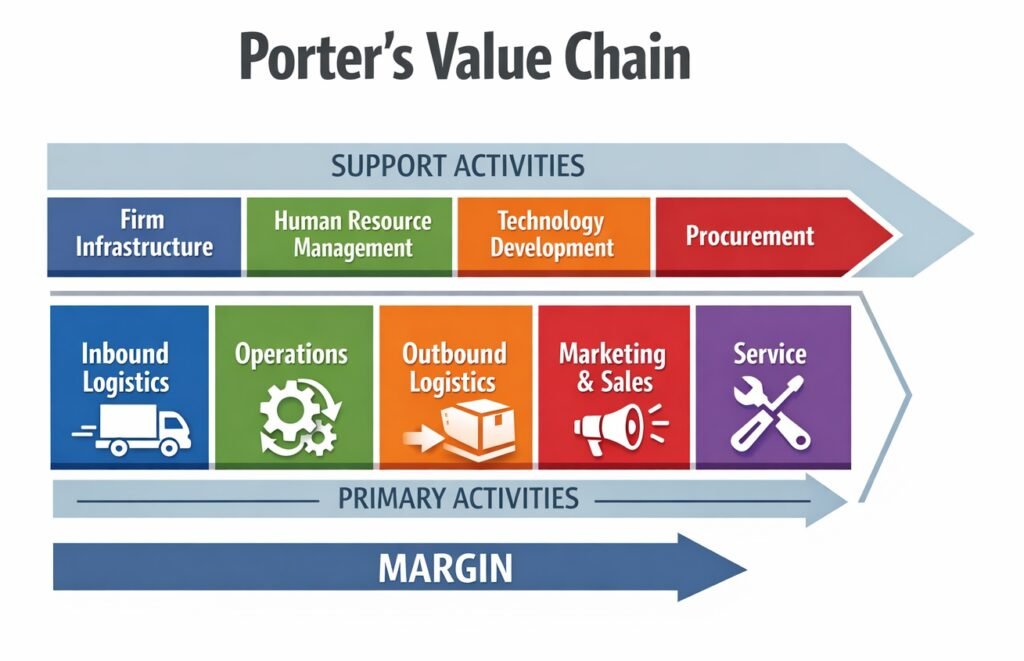
Primary Activities
1. Inbound Logistics
Inbound logistics involves the receiving, storing, and distributing of inputs (raw materials, components, supplies) from suppliers to production. Activities include materials handling, warehousing, inventory control, vehicle scheduling, and returns to suppliers. Efficient inbound logistics reduces storage costs, minimizes production delays, and ensures quality inputs reach operations just when needed. For example, Toyota’s just-in-time system dramatically reduces warehouse space while preventing production line stoppages. Inbound logistics contributes to competitive advantage through cost reduction (lower inventory holding, efficient scheduling) or differentiation (careful handling of fragile premium materials, reliable availability). Value is created by ensuring the right inputs, in right quantity, at right place, at right time, with minimal damage.
2. Operations
Operations convert inputs into final product form through manufacturing, assembly, packaging, equipment maintenance, facility management, testing, and quality control. This activity creates value by transforming raw materials into something customers value more highly than the sum of its parts. Competitive advantage in operations comes from: higher throughput (more output from same inputs), lower defect rates (less rework and waste), faster changeover times (flexibility), energy efficiency, proprietary production technology, or superior process design. For example, Dell’s build-to-order operations eliminated finished goods inventory while enabling customization. Operations decisions involve trade-offs: cost efficiency vs. flexibility; standardization vs. customization; automation vs. skilled labor. Operations excellence differentiates commodity producers.
3. Outbound Logistics
Outbound logistics collects, stores, and distributes finished products to customers. Activities include finished goods warehousing, order processing, picking and packing, delivery vehicle scheduling, and distribution channel management. Value is created by getting products to customers quickly, accurately, and in undamaged condition—often at lower cost than competitors. Outbound logistics drives competitive advantage through: faster delivery (reducing customer waiting time), reliable delivery windows (enabling customer production scheduling), real-time tracking (reducing customer uncertainty), convenient return handling, or lower shipping costs (absorbed or passed as lower prices). Amazon’s outbound logistics (fulfillment centers strategically located, proprietary delivery network) creates customer value through speed and reliability that competitors struggle to match.
4. Marketing and Sales
Marketing and sales activities induce customers to purchase products and differentiate offerings from competitors. Activities include advertising, promotion, sales force management, pricing strategy, channel selection, brand building, customer segmentation, and market research. Value is created by communicating product benefits, reducing customer search costs, building trust through brand reputation, offering convenient purchasing channels, and justifying premium prices. Competitive advantage arises from: superior brand equity (customers pay more for known quality), efficient customer acquisition (lower cost per order), effective upselling/cross-selling, or innovative go-to-market models (direct sales, e-commerce, subscription). For example, Apple’s marketing creates perceived value exceeding technical specifications through aspirational branding and integrated retail experiences.
5. Service
Service activities maintain and enhance product value after purchase, including installation, training, repairs, maintenance, technical support, warranty handling, returns processing, and customer education. In many industries, service is where long-term customer relationships are built or destroyed. Value is created by reducing customer post-purchase costs (reliability), reducing customer risk (warranty), increasing customer capability (training), or solving problems quickly (responsive support). Competitive advantage comes from: faster response times, higher first-time fix rates, self-service options (lower cost, customer convenience), proactive maintenance (preventing failures), or service contracts providing recurring revenue. For example, Caterpillar’s dealer network provides parts within 24 hours globally—service advantage that justifies premium pricing over competitors.
Support Activities
6. Firm Infrastructure
Firm infrastructure includes general management, planning, finance, accounting, legal, quality management, government relations, and information systems—activities that support the entire value chain rather than individual primary activities. Infrastructure creates value by: providing strategic direction (vision, mission), allocating capital efficiently, managing risk (compliance, insurance), maintaining investor confidence, and coordinating across activities. Competitive advantage arises from: superior strategic planning processes, lower overhead costs, faster decision-making, better information systems integration, or more effective stakeholder management. For example, Walmart’s infrastructure investment in satellite communication and data analytics (historically unusual for a retailer) enabled real-time inventory coordination across thousands of stores, creating cost advantage competitors could not replicate without similar infrastructure scale.
7. Human Resource Management
Human resource management (HRM) comprises activities involved in recruiting, hiring, training, developing, rewarding, and retaining employees across all value chain activities. HRM creates value by ensuring the organization has people with appropriate skills, motivation, and behaviors to perform each activity effectively. Competitive advantage arises from: superior talent acquisition (attracting better candidates), effective training (developing skills faster), performance management systems (aligning incentives with strategy), retention practices (protecting tacit knowledge), and culture building (shaping behaviors without constant supervision). For example, Southwest Airlines’ HRM selects for attitude (humor, teamwork) then trains for skill—creating a productive, engaged workforce that delivers faster aircraft turnaround times than competitors. HRM’s strategic role varies: cost leaders emphasize efficiency; differentiators emphasize creativity and customer empathy.
8. Technology Development
Technology development includes activities related to product R&D, process improvement, equipment design, software development, and technical knowledge acquisition—not just high-tech industries but any application of technology to improve value chain activities. Technology development creates value by: enabling new products (differentiation), reducing production costs (process innovation), improving quality (defect reduction), accelerating response times (information systems), or creating patent barriers (imitability). Competitive advantage arises from faster innovation cycles, proprietary technologies, or superior technology integration across activities. For example, Toyota’s technology development in lean manufacturing (kanban, jidoka) transformed operations efficiency. Technology development differs from procurement (buying technology) and operations (using technology)—it is the intentional, systematic enhancement of knowledge applied to organizational activities.
9. Procurement
Procurement is the function of purchasing inputs used throughout the value chain—raw materials for operations, machinery for manufacturing, office supplies for infrastructure, travel services for sales, training services for HRM. Unlike inbound logistics (movement and storage), procurement focuses on supplier selection, negotiation, contracting, and relationship management. Value is created by: obtaining lower prices (direct cost reduction), securing higher quality inputs (enabling differentiation), ensuring reliable supply (preventing disruptions), or accessing supplier innovation (collaborative development). Competitive advantage arises from: scale economies in purchasing, long-term supplier partnerships (lower transaction costs), global sourcing expertise, or ethical sourcing (reputation differentiation). For example, McDonald’s procurement coordinates millions of pounds of potatoes, beef, and packaging globally—consistency and cost advantage embedded in long-term supplier relationships with detailed performance specifications.
10. Margin (Not an Activity but the Objective)
Margin is the value created by performing activities at cost lower than customer willingness to pay—the difference between total value (customer perceived benefit) and total cost of performing all value chain activities. Margin is not a separate activity but the objective measure of overall value chain effectiveness. Positive margin indicates the organization creates more value than it consumes. Margin analysis reveals: which activities contribute most to value creation (high value at low cost), which activities destroy value (cost exceeds customer willingness to pay), and trade-off opportunities (reducing costs in low-value activities to fund investment in high-value activities). Margin can be increased by: reducing activity costs (without reducing customer value), increasing customer perceived value (without increasing costs), or both simultaneously (innovation). Margin finances reinvestment, shareholder returns, and organizational survival.
Advantages of Value Chain:
1. Cost Advantage
Value chain analysis helps in identifying areas where costs can be reduced. By examining each activity, organizations can remove inefficiencies and avoid unnecessary expenses. It improves resource utilization and increases operational efficiency. This leads to lower production costs and higher profitability. Managers can focus on cost effective processes and improve pricing strategies. Overall, value chain provides a clear understanding of cost structure and supports better financial control within the organization.
2. Competitive Advantage
Value chain helps organizations gain a competitive edge by improving performance in key activities. It allows firms to focus on areas where they can outperform competitors. By enhancing quality, reducing costs, or improving service, businesses can create differentiation. This strengthens market position and attracts more customers. It also supports long term sustainability. Overall, value chain helps organizations stand out in the market and achieve superior performance.
3. Better Coordination
Value chain analysis improves coordination among different business activities. It ensures that all departments work in alignment with organizational goals. This reduces duplication of work and improves communication between functions. Better coordination leads to smoother operations and increased productivity. It also helps in faster decision making. Overall, value chain creates a systematic approach that integrates all activities effectively within the organization.
4. Identification of Strengths and Weaknesses
Value chain helps in identifying the strengths and weaknesses of an organization. By analyzing each activity, managers can understand where the firm performs well and where improvement is needed. This supports better planning and strategy formulation. It helps in focusing on core competencies and improving weaker areas. Overall, value chain analysis provides a clear picture of internal capabilities and supports better decision making.
5. Value Creation for Customers
Value chain focuses on creating value at every stage of business activities. It helps organizations improve product quality, service, and customer satisfaction. By adding value, businesses can charge better prices and build strong customer relationships. It also increases brand loyalty. Overall, value chain ensures that customer needs are met effectively and enhances the overall market reputation of the organization.
Challenges of Value Chain:
1. Difficulty in Activity Disaggregation
Defining where one activity ends and another begins is inherently subjective. Inbound logistics overlaps with operations; marketing blends into service. Managers may disaggregate too finely (creating hundreds of meaningless micro-activities) or too coarsely (missing critical value sources). This ambiguity reduces analytical precision and comparability across firms or time periods. Without clear, consistent boundaries, value chain analysis becomes an exercise in arbitrary categorization rather than strategic insight. Organizations must develop standardized activity definitions tailored to their specific industry and competitive logic.
2. High Data Collection Costs
Value chain analysis requires detailed cost, time, and quality data at activity level—far beyond what traditional accounting systems provide. Activity-based costing implementations are expensive, time-consuming, and resisted by employees. Small and medium enterprises often cannot afford the information systems and analytical expertise required. Even large organizations struggle to maintain activity-level data currency. The cost-benefit trade-off is real: exhaustive value chain analysis may consume more resources than the value of insights generated. Pragmatic organizations prioritize analysis on activities where competitive advantage likely resides.
3. Capturing Activity Linkages
Value chain analysis must account for interdependencies—how performing one activity affects cost or effectiveness of others. However, linkages are difficult to identify, measure, and optimize. Improving a single activity (e.g., reducing quality inspection) may increase costs elsewhere (more after-sales repairs). Traditional functional structures, where each department optimizes its own activities, actively obscure linkages. Capturing linkages requires cross-functional teams, integrated information systems, and aligned incentives—all challenging to implement. Most organizations suboptimize individual activities, never achieving total value chain coordination that generates sustainable competitive advantage.
4. Dynamic and Rapidly Changing Environments
Value chain analysis produces a static snapshot, but competitive environments change continuously. A superior activity configuration today becomes obsolete tomorrow as competitors imitate, technologies advance, or customer preferences shift. The analysis must be repeated frequently to remain relevant—but resource constraints limit refresh cycles. In fast-moving industries (technology, fashion, digital services), by the time value chain analysis completes, the strategic landscape has already transformed. Organizations risk making multi-year investments based on outdated activity maps. Dynamic value chain analysis requires real-time data, short analysis cycles, and organizational willingness to reconfigure activities rapidly.
5. Benchmarking Data Unavailability
Comparing activity-level performance against competitors requires detailed, reliable benchmarking data—which competitors rarely disclose publicly. Trade associations, industry consultants, and reverse engineering provide partial information, but confidentiality limits depth. Without benchmarks, organizations cannot distinguish genuine competitive advantage from parity or weakness. They may celebrate activity performance that is actually industry-average or below. Even internal benchmarking across business units faces transferability challenges: what works in one context may not apply elsewhere due to different scale, technology, or customer segments. Data unavailability forces reliance on estimates and assumptions, reducing analytical validity.
6. Internal Resistance to Transparency
Value chain analysis reveals which activities are inefficient, which departments destroy value, and which managers underperform. This transparency threatens organizational politics, career interests, and departmental budgets. Powerful managers resist activity-level scrutiny, hide unfavorable data, or manipulate activity definitions to protect their units. Cross-functional value chain optimization inevitably creates winners (activities receiving investment) and losers (activities targeted for cost reduction or outsourcing). Losers resist change, sometimes sabotaging implementation. Value chain analysis is therefore not purely technical but deeply political. Success requires senior management commitment, protected analytical teams, and change management expertise to overcome internal resistance.
7. Over-Emphasis on Cost Reduction
Value chain analysis often becomes cost-cutting exercise rather than value-creation discipline. Managers focus on reducing activity costs—visible, measurable, rewarded—while ignoring differentiation opportunities that increase customer willingness to pay. The resulting “lean” value chain may produce acceptable products at low cost but fails to command premium prices or build customer loyalty. Long-term competitive advantage more often comes from unique value creation than from cost minimization (except in commodity industries). Effective value chain analysis balances cost and value perspectives, but organizational incentives and short-term performance pressure bias attention toward easily quantifiable cost reductions at expense of harder-to-measure differentiation investments.
8. Supply Chain Integration Complexity
Extending value chain analysis beyond organizational boundaries to include suppliers (upstream) and distributors/customers (downstream) multiplies complexity exponentially. Each external partner has different information systems, performance metrics, strategic priorities, and trust levels. Achieving activity-level coordination across independent firms requires unprecedented transparency, contractual alignment, and governance mechanisms. Partners may fear opportunism sharing cost data enables buyer to squeeze margins. Even with good relationships, integrating multiple value chains (supplier’s suppliers, customer’s customers) creates coordination costs that may exceed integration benefits. Many organizations revert to adversarial arm’s-length relationships, forfeiting supply chain value creation opportunities due to complexity and trust barriers.
