 by
by
1. Customer Convenience
One key objective of retail formats is to provide maximum convenience to customers. Different formats like supermarkets, malls and online stores are designed to make shopping easy and quick. Retailers focus on location, store layout and accessibility. Customers should find products easily without wasting time. Facilities like parking, billing counters and digital payments improve convenience. Online formats provide home delivery and 24/7 access. This objective helps in attracting more customers and improving satisfaction. Convenient shopping experiences encourage repeat visits and build customer loyalty. Retailers design formats according to customer needs to ensure smooth and comfortable shopping.
2. Product Variety and Availability
Retail formats aim to offer a wide range of products to meet different customer needs. Supermarkets and department stores provide multiple categories under one roof. This saves time and effort for customers. Retailers ensure continuous availability of goods to avoid shortages. Variety helps customers compare products and make better choices. It also attracts more customers to the store. Proper product assortment increases sales and customer satisfaction. This objective ensures that retailers can meet diverse consumer preferences effectively in a competitive market environment.
3. Efficient Operations
Retail formats are designed to improve operational efficiency. Proper layout, technology use and organized systems help in smooth functioning of the store. Efficient operations reduce time, cost and errors. Retailers use billing systems, inventory management and logistics to improve performance. This objective helps in maintaining quality service and reducing operational problems. Efficient systems also improve employee productivity. Retail formats focus on minimizing wastage and maximizing output. This leads to better profitability and customer satisfaction. Operational efficiency is essential for the success and sustainability of retail businesses.
4. Profit Maximization
Retail formats aim to generate maximum profit through effective sales and cost management. Proper pricing strategies, cost control and increased sales volume help in achieving this objective. Retailers design formats to attract more customers and encourage higher spending. Promotions, discounts and product placement are used to boost sales. Efficient operations also reduce costs and increase margins. Profit maximization ensures business growth and sustainability. It allows retailers to expand and invest in new opportunities. This objective is essential for the long term success of any retail format.
5. Brand Building and Image Creation
Retail formats help in creating a strong brand image in the market. Attractive store design, quality products and good customer service contribute to brand building. Retailers aim to create a unique identity that differentiates them from competitors. Consistency in service and product quality builds trust among customers. A strong brand image attracts more customers and increases loyalty. Retail formats are designed to reflect the brand’s values and positioning. This objective helps retailers gain a competitive advantage and maintain a strong presence in the market.
6. Customer Experience Enhancement
Improving customer experience is an important objective of retail formats. Retailers focus on store atmosphere, product display and service quality. A pleasant shopping environment makes customers feel comfortable and satisfied. Personalized services and quick billing improve experience. Online formats provide easy navigation and fast delivery. Good experience encourages customers to return and recommend the store. Retailers continuously improve their formats based on customer feedback. This objective helps in building long term relationships and increasing sales. Customer experience plays a key role in the success of retail businesses.
Types of Retail Formats:
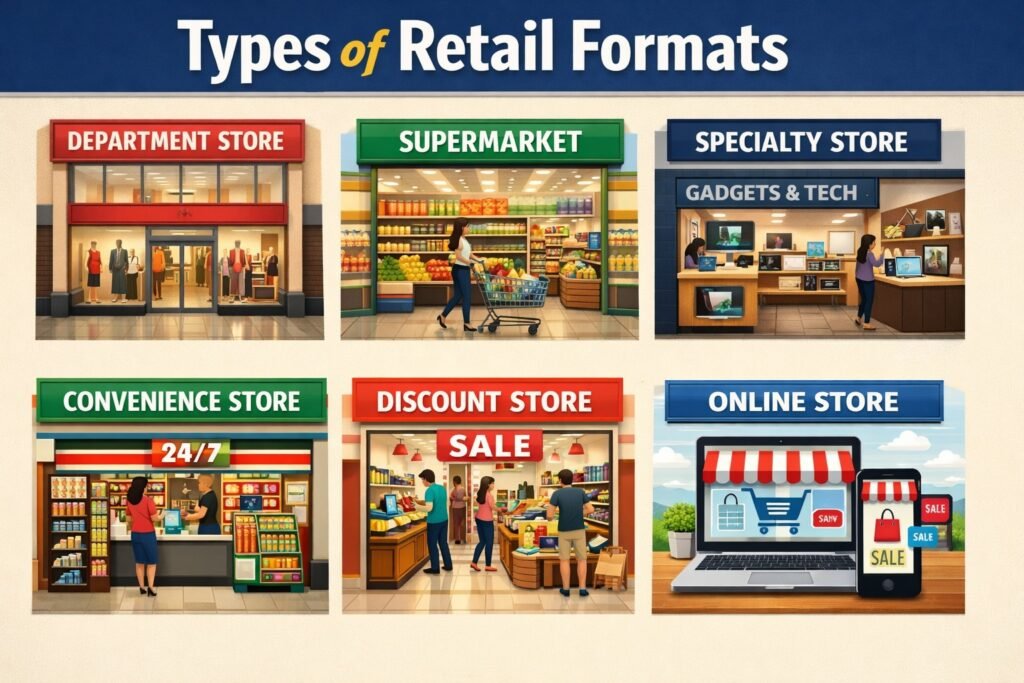
1. Convenience Stores
Convenience stores are small-format retail outlets located in residential neighborhoods, gas stations, or high-footfall urban corners, typically 500-2,000 square feet. They stock essential, high-turnover products like snacks, beverages, milk, bread, eggs, tobacco, over-the-counter medicines, and basic household items. The defining extended operating hours (often 24/7) and extreme proximity to customers. Prices are higher than supermarkets because customers pay a premium for convenience and time savings. Globally, 7-Eleven, Circle K, and FamilyMart lead; in India, 24Seven and traditional kirana stores modified for convenience serve this role. The format thrives on impulse purchases, emergency needs, and fill-in shopping between major grocery trips. Quick commerce apps now compete directly, offering delivery in 10-20 minutes, challenging the convenience store value proposition.
2. Supermarkets
Supermarkets are self-service food and grocery stores offering a wide but not exhaustive range of household essentials, fresh produce, dairy, bakery, meat, fish, and packaged foods. Store sizes typically range from 1,000 to 10,000 square feet. Unlike hypermarkets, supermarkets focus primarily on food and daily needs, with limited general merchandise. Customers browse aisles, select products themselves, and pay at central checkout counters. Examples include Reliance Smart Point, Spencer’s, More, and BigBasket’s physical stores. Supermarkets compete on convenience of one-stop grocery shopping, competitive pricing through bulk buying, and consistent product quality. They face intense competition from traditional kirana stores (personalized service, credit) and quick commerce (delivery speed). Successful supermarket chains invest in fresh produce sections, private labels, and loyalty programs to retain price-sensitive but time-constrained urban customers.
3. Hypermarkets
Hypermarkets are massive retail establishments (30,000 to 200,000+ square feet) combining a full-service supermarket with extensive general merchandise—electronics, apparel, furniture, appliances, toys, auto accessories, and more. They embody the “one-stop mega shop” concept where families can complete all their shopping in a single trip. Examples include D-Mart (India), Walmart (global), Carrefour (Europe), Target (US), Lulu Hypermarket (Middle East/India), and Big Bazaar (before restructuring). Hypermarkets operate on high-volume, low-margin economics, leveraging bulk purchasing, efficient supply chains, and private labels. They require significant real estate, ample parking, and often include attached food courts, service counters, banking, and entertainment zones. Challenges include high operating costs, competition from category killers and e-commerce, and declining footfalls in some saturated markets. Successful hypermarkets differentiate through aggressive pricing, fresh food quality, and store-brand exclusives.
4. Department Stores
Department stores are large retail establishments offering a wide variety of product categories—apparel, footwear, cosmetics, jewelry, home furnishings, electronics, toys, and sometimes groceries—organized into distinct departments, each managed as a separate profit center within a single building. Unlike hypermarkets focused on value and bulk, department stores emphasize assortment depth, brand variety, ambiance, and customer service. Examples include Shoppers Stop, Lifestyle, Westside, Pantaloons (India), Macy’s (US), and Galeries Lafayette (France). Department stores provide convenience for one-stop family shopping across multiple price points and styles. They frequently offer personal shopping, gift wrapping, alterations, loyalty programs, and in-store restaurants. The format faces pressure from specialty stores (deeper category expertise), discounters (lower prices), and e-commerce. Modern department stores are shrinking floor space, launching shop-in-shop concepts for premium brands, and integrating online-offline channels to survive.
5. Specialty Stores
Specialty stores concentrate on a narrow product category or a specific range of related items, offering deep assortment, expert knowledge, and often premium service within that category. Examples include Nike (sportswear only), Apple (electronics), Titan Eye+ (eyewear), Tanishq (jewelry), Crossword (books), and Sephora (beauty). Store sizes vary but are typically smaller than department stores, ranging from 500 to 5,000 square feet. Specialty stores attract serious buyers seeking variety, quality, and expertise that generalist retailers cannot provide. Staff receive extensive product training, often offering demonstrations, customization, or after-sales support. The format competes on curation and authority rather than lowest price. Challenges include vulnerability to category disruption (e-commerce can offer even deeper assortment) and economic downturns when consumers postpone discretionary purchases. Successful specialty stores build brand communities and experiential retail (workshops, events, personal consultations).
6. Category Killers
Category killers are large-format specialty stores (20,000 to 100,000+ square feet) that dominate a specific product category by offering overwhelming selection, competitive pricing, and high volume, often driving smaller niche competitors out of business (“killing” product categories). Examples include Decathlon (sports equipment), HomeTown (home furnishings and furniture), Electronics Bazaar (consumer electronics), PetSmart (pet supplies globally), and Best Buy (electronics in US). Category killers leverage massive buying power, efficient supply chains, purpose-built large stores, and deep category expertise. They typically locate in peripheral retail parks or power centers with ample parking. The format competes on both assortment depth (thousands of SKUs within a category) and price. Challenges include vulnerability to e-commerce (online can provide even deeper selection and convenience), large real estate footprints becoming burdensome, and showrooming (customers browse in-store, buy cheaper online). Successful category killers have integrated omnichannel capabilities, including buy-online-pickup-in-store.
7. Discount Stores and Warehouse Clubs
Discount stores offer products at prices significantly lower than traditional retailers by operating on ultra-low margins, minimal store amenities, limited customer service, and high inventory turnover. Examples include Walmart (supercenters), Target, and in India, D-Mart operates as a discount-focused hypermarket. Sub-format warehouse clubs (Costco, Sam’s Club, Metro Cash & Carry) require membership fees, sell in bulk quantities (large pack sizes), and have no-frills warehouse-like environments. These retailers achieve low prices through bulk purchasing, efficient logistics, private labels (Kirkland Signature at Costco), and reduced labor costs (customers often pack their own goods). Warehouse clubs generate most profit from membership fees rather than product margins. The format appeals to value-seeking bulk buyers, small businesses, and families. Challenges include high inventory investment, need for large storage space, and competition from e-commerce bulk purchasing options.
8. E-Retailers (Online Retail)
E-retailers operate exclusively through digital channels—websites, mobile apps, or social commerce platforms—without physical storefronts for customer shopping (though they may have warehouses). Formats include pure-play marketplaces (Amazon, Flipkart, eBay) connecting third-party sellers with buyers; pure-play inventory-based (earlier Junglee, though limited in India due to FDI rules); and direct-to-consumer (D2C) brand websites. E-retailers offer unlimited virtual shelf space, personalized recommendations using AI, user reviews and ratings, easy price comparison across sellers, home delivery, and 24/7 convenience. Success drivers include fast shipping, easy returns, secure payments (UPI, cards, COD), user-friendly interface, and trust-building mechanisms. Challenges include high customer acquisition costs (digital marketing), thin or negative margins due to discounting, logistics complexity (especially reverse logistics), showrooming, and regulatory scrutiny. Many e-retailers are now opening physical experience stores (omnichannel shift).
9. Omnichannel Retailers
Omnichannel retailers seamlessly integrate physical stores, e-commerce websites, mobile apps, social commerce, and catalogs into a unified customer experience. Unlike multichannel (channels operate separately), omnichannel enables actions like buying online and returning in-store, checking local store inventory via app, ordering in-store for home delivery, and scanning QR codes for instant purchase. Examples include Target (US), Tesco (UK), and in India, Croma, Westside, Reliance Digital, and D-Mart (via D-Mart Ready). Key capabilities include unified customer profiles (single login across channels), real-time inventory visibility across all locations, consistent pricing/promotions, and integrated fulfillment (ship-from-store, BOPIS). Omnichannel requires significant technology investment (POS, inventory management, CRM integration) and organizational restructuring to break down online-offline silos. The format increases customer lifetime value (omnichannel customers spend 15-30% more) but demands sophisticated operations.
10. Pop-Up and Temporary Stores
Pop-up stores are temporary retail spaces that operate for a short duration—days to a few months—often in high-footfall locations like mall atriums, event spaces, vacant storefronts, or outdoor markets. Brands use pop-ups for seasonal selling (Christmas, Diwali), product launches, test marketing new concepts without long-term commitment, creating buzz/exclusivity, or clearing excess inventory. Rent for pop-ups is typically higher per day than permanent leases, but total commitment is low. Examples include fashion brands opening Diwali pop-ups, D2C brands testing physical retail before permanent stores, or food brands operating temporary kiosks. The format offers flexibility, low-risk market entry, and experiential marketing opportunities. Challenges include lack of repeat customers, logistical complexity for short duration, and difficulty in building lasting brand loyalty. Post-COVID, pop-ups have grown as landlords offer flexible short-term leases to fill vacant spaces.
11. Vending Machines (Automatic Retail)
Vending machines are automated, unmanned retail units that dispense products to customers after payment, operating 24/7 without staff. Traditional vending sold snacks, beverages, cigarettes, and coffee. Modern vending machines (smart vending) offer fresh food, electronics, cosmetics, personal care items, even gold coins and car oil. They accept cash, cards, and UPI/digital wallets, with some featuring touchscreens, inventory tracking, and remote monitoring. Vending machines are placed in transit hubs (airports, metro stations, railway stations), offices, hospitals, universities, and hotels—locations with foot traffic but insufficient volume for a manned store. In India, vending penetration is low compared to Japan (where millions of machines exist) but growing through companies like Vendiman, NexVend, and park+, especially in metro stations and corporate campuses. Challenges include machine maintenance, cash handling (though declining), product freshness for food, and theft prevention.
12. Service Retailers
Service retailers sell intangible products—experiences, expertise, labor, or access—rather than physical goods. This format includes salons and spas (Lakmé Salon, Jawed Habib, Naturals), gyms and fitness centers (Cult.fit, Gold’s Gym), hotels (Taj, OYO), airlines (IndiGo), restaurants (McDonald’s, Domino’s, Barista), banks (HDFC, SBI branches), insurance agencies, educational coaching centers (FIITJEE, BYJU’S offline centers), healthcare clinics (Apollo Clinics), car rentals (Zoomcar), and laundry services. Unlike product retailers, services are perishable (an empty gym class or hotel room generates zero revenue), variable in quality (depends on the provider), and require customer participation during delivery. Retail management in services focuses on employee training, service standardization, appointment scheduling, ambiance, wait time management, and customer feedback systems. Loyalty programs, subscriptions/memberships, and dynamic pricing are common strategies. Service retailing is location-sensitive and relies heavily on reputation, referrals, and online reviews (Google Maps, Zomato, Practo).
13. Franchise Stores
Franchise stores operate under a contractual arrangement where the franchisor (brand owner) grants the franchisee (operator) rights to use its brand name, business systems, products, and marketing in exchange for upfront fees and ongoing royalties (typically 5-10% of sales). This format allows rapid geographic expansion with reduced capital risk for the brand owner. Franchisees gain access to established brand recognition, proven operating procedures, training, bulk purchasing benefits, and ongoing support. Examples include fast-food chains (McDonald’s, KFC, Subway, Domino’s, Pizza Hut), education centers (Kumon, EuroKids), salons (Lakmé Salon franchise), and retail stores (Bata, Jumbo Electronics). Success depends on franchisor-franchisee relationship quality, territory selection, adherence to brand standards, and mutual profitability. Challenges include loss of operational control for brand owners, risk of brand damage from underperforming franchisees, and legal complexity of franchise agreements across different jurisdictions.
14. Cash & Carry (Wholesale Retail)
Cash & Carry, also known as wholesale retail or warehouse club for businesses, serves small businesses, restaurants, hotels, caterers, kirana stores, and institutional buyers rather than individual consumers. Customers buy in bulk quantities at wholesale prices, pay without credit (cash or digital), and transport goods themselves. Unlike traditional wholesale, Cash & Carry is open to registered business customers (sometimes general public with membership) in a self-service warehouse environment. Examples include Metro Cash & Carry (India), Walmart’s Best Price (India), and Reliance Market. The format benefits small businesses that lack storage or bargaining power to buy directly from manufacturers. Product range includes food staples, vegetables, frozen foods, cleaning supplies, office stationery, and hospitality equipment. Challenges include thin margins (volume-driven), need for large warehouse spaces (50,000-100,000 sq ft), logistics for bulk handling, and competition from B2B e-commerce platforms (Udaan, Ninjacart) that deliver directly to business doors.
Factors affecting Retail Formats:
1. Consumer Behaviour
Consumer behaviour is a major factor influencing retail formats. Preferences, income levels, lifestyle and buying habits determine the type of retail format customers prefer. For example, busy consumers may choose supermarkets or online stores for convenience. Price sensitive customers may prefer discount stores or local shops. Changes in trends and expectations force retailers to modify their formats. Understanding consumer needs helps retailers design suitable store layouts, product ranges and services. Failure to match customer expectations can reduce sales. Thus, studying consumer behaviour is essential for selecting and developing effective retail formats in the market.
2. Economic Conditions
Economic factors such as income levels, inflation and purchasing power affect retail formats. In strong economic conditions, consumers spend more on branded and premium products, encouraging the growth of malls and organized retail. During economic slowdown, customers prefer low cost formats like discount stores and local shops. Retailers must adjust their formats according to economic conditions. High operating costs and investment requirements also influence format selection. Understanding the economic environment helps retailers make better decisions regarding pricing, location and store size. Economic conditions play a key role in shaping retail formats and their success.
3. Technology Advancement
Technological development significantly affects retail formats. The growth of e commerce, digital payments and mobile apps has led to the rise of online retailing. Retailers use technology for billing, inventory management and customer analysis. Advanced systems improve efficiency and customer experience. Omnichannel retailing combines online and offline formats. Retailers must adopt suitable technology to stay competitive. Lack of technology can limit growth. Continuous innovation requires investment and training. Technology influences how products are sold, promoted and delivered. It plays a crucial role in shaping modern retail formats.
4. Competition Level
The level of competition in the market influences retail formats. Presence of many retailers offering similar products forces businesses to adopt better and unique formats. Retailers design attractive store layouts, offer better services and introduce new formats to stand out. High competition encourages innovation and efficiency. It also affects pricing and promotional strategies. Retailers must analyze competitors and market trends. Choosing the right format helps in gaining a competitive advantage. Strong competition shapes the development and success of retail formats in the market.
5. Location and Infrastructure
Location is a key factor affecting retail formats. Availability of space, accessibility and customer traffic influence the type of format used. Prime locations support large formats like malls and supermarkets, while small areas suit local shops. Infrastructure such as roads, transport and utilities also plays an important role. Good location attracts more customers and increases sales. Retailers must carefully select locations based on target market. Poor location can lead to business failure. Thus, location and infrastructure are critical in deciding retail formats and their performance.
6. Government Policies and Regulations
Government rules and regulations affect retail formats. Policies related to taxation, licensing, labor laws and foreign investment influence retail operations. Retailers must follow legal requirements while setting up and managing stores. Favorable policies encourage growth of organized retail and modern formats. Strict regulations may limit expansion. Government initiatives like digital payment promotion also impact retail formats. Understanding legal requirements helps retailers operate smoothly. Compliance is necessary to avoid penalties. Thus, government policies play an important role in shaping retail formats and their development.
Limitations of Retail Formats:
1. High Investment Requirement
Many retail formats, especially malls, supermarkets and department stores, require large capital investment. Costs include store setup, rent, infrastructure, technology and inventory. Small retailers may find it difficult to invest such high amounts. This limits entry and expansion opportunities. High investment also increases financial risk if sales are low. Retailers must carefully plan before adopting such formats. This limitation affects profitability and growth, especially in competitive markets where returns may take time.
2. High Operating Costs
Retail formats involve continuous expenses such as rent, salaries, electricity and maintenance. Modern formats with large spaces and advanced facilities have higher costs. These expenses reduce profit margins and create financial pressure. Retailers must maintain high sales to cover these costs. Managing expenses becomes difficult during low demand periods. High operating costs are a major limitation, especially for organized retail formats in urban areas.
3. Limited Flexibility
Some retail formats lack flexibility in adapting to market changes. Large stores and malls cannot be easily modified or relocated. Changes in layout, product range or pricing may take time and cost. This makes it difficult to respond quickly to changing customer preferences. In contrast, small retailers can adapt faster. Limited flexibility can affect competitiveness and customer satisfaction.
4. Intense Competition
Retail formats face strong competition from both traditional and modern retailers. Similar formats offering similar products make it difficult to attract customers. Price competition reduces profit margins. Retailers must continuously innovate to stay competitive. This increases pressure and operational challenges. High competition can lead to reduced market share and profitability.
5. Dependence on Location
Many retail formats depend heavily on location for success. Poor location with low customer traffic can lead to low sales. High demand locations have expensive rent, increasing costs. Choosing the right location is difficult and risky. Once selected, changing location is not easy. This dependence limits flexibility and affects business performance.
6. Technology Dependence
Modern retail formats rely heavily on technology for billing, inventory and customer management. Technology requires investment, maintenance and skilled staff. System failures or technical issues can disrupt operations. Small retailers may struggle to adopt advanced technology. Dependence on technology increases cost and complexity. It also requires continuous upgrades to stay competitive.
