by
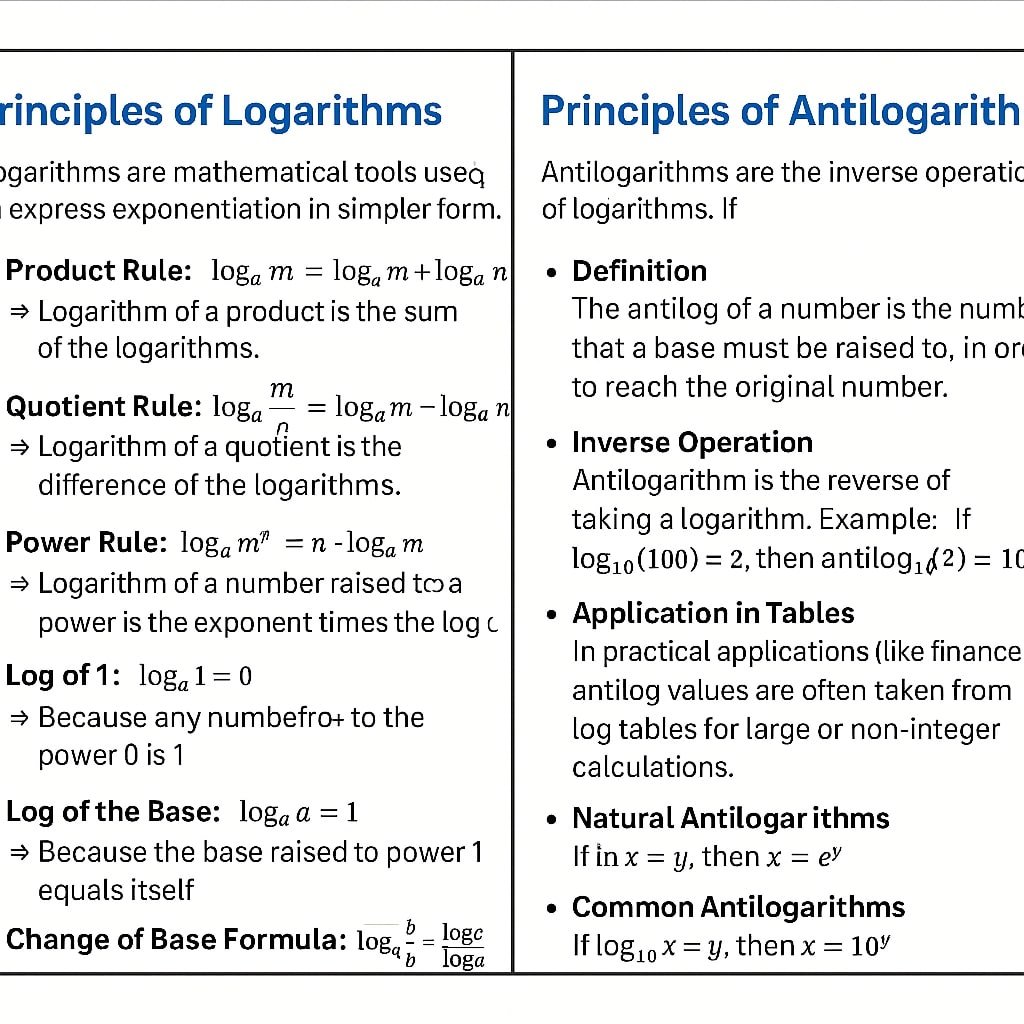
by Logarithms are mathematical tools that help simplify complex calculations, especially those involving very large or very small numbers. A logarithm is the power or exponent to which a base number must be raised to produce a given number. The basic logarithmic identity is:
If a^x = b, then log^ab = x
Antilogarithms, on the other hand, are the inverse of logarithms. If you have a logarithm, the antilogarithm returns the original number.
Logarithms and antilogarithms are widely used in business for financial calculations like compound interest, depreciation, and forecasting. They convert multiplication and division problems into addition and subtraction, saving time and reducing errors.
In the pre-calculator era, logarithmic and antilogarithmic tables were essential tools for engineers, scientists, and accountants. Even today, understanding their logic is critical for mastering complex business mathematics.
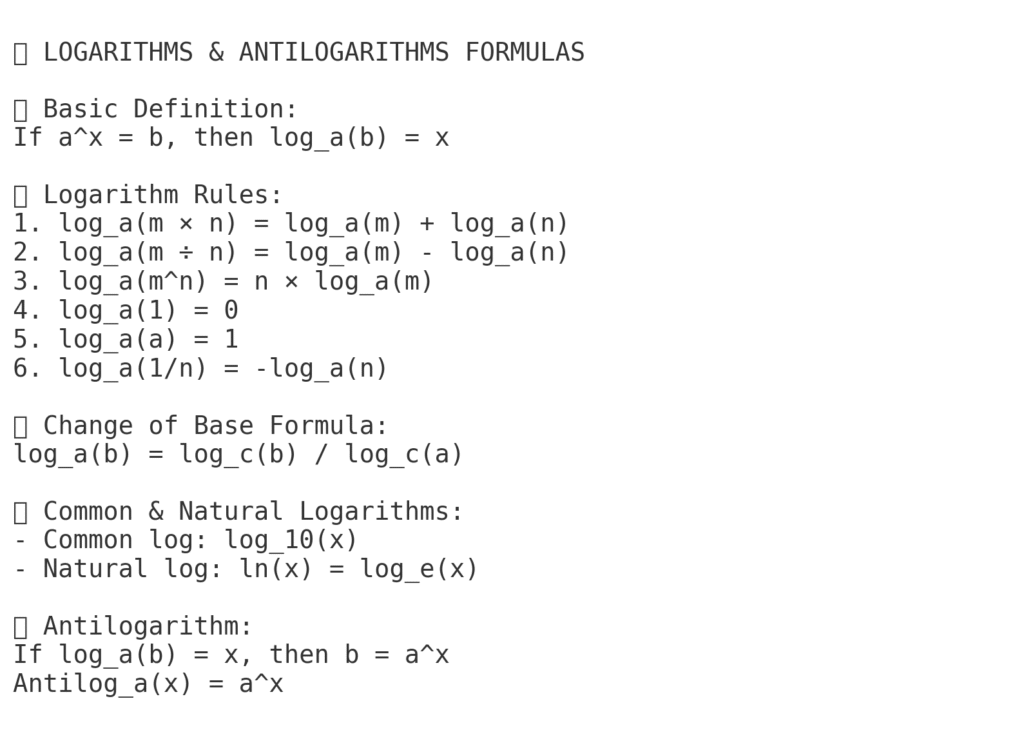
Examples of Logarithms and Antilogarithms:
Logarithms Examples:
1. log₁₀(100) = 2
Because 10² = 100
2. log₂(8) = 3
Because 2³ = 8
3. log₁₀(0.01) = -2
Because 10⁻² = 0.01
4. logₑ(e⁴) = 4
Natural log form: ln(e⁴) = 4
5. log₁₀(1) = 0
Because 10⁰ = 1
6. log₅(25) = 2
Because 5² = 25
Antilogarithms Examples:
1. Antilog₁₀(2) = 100
10² = 100
2. Antilog₂(3) = 8
2³ = 8
3. Antilog₁₀(-2) = 0.01
10⁻² = 0.01
4. Antilogₑ(4) = e⁴ ≈ 54.598
e raised to power 4
5. Antilog₁₀(0) = 1
10⁰ = 1
6. Antilog₃(4) = 81
3⁴ = 81
Use in Business Mathematics:
- Logarithms and antilogarithms are especially useful in:
- Compound interest calculations
- Exponential growth & decay
- Financial modeling
- Depreciation calculations
- Data compression (log scales)
- Solving equations involving powers
Principles of Logarithms and Antilogarithms